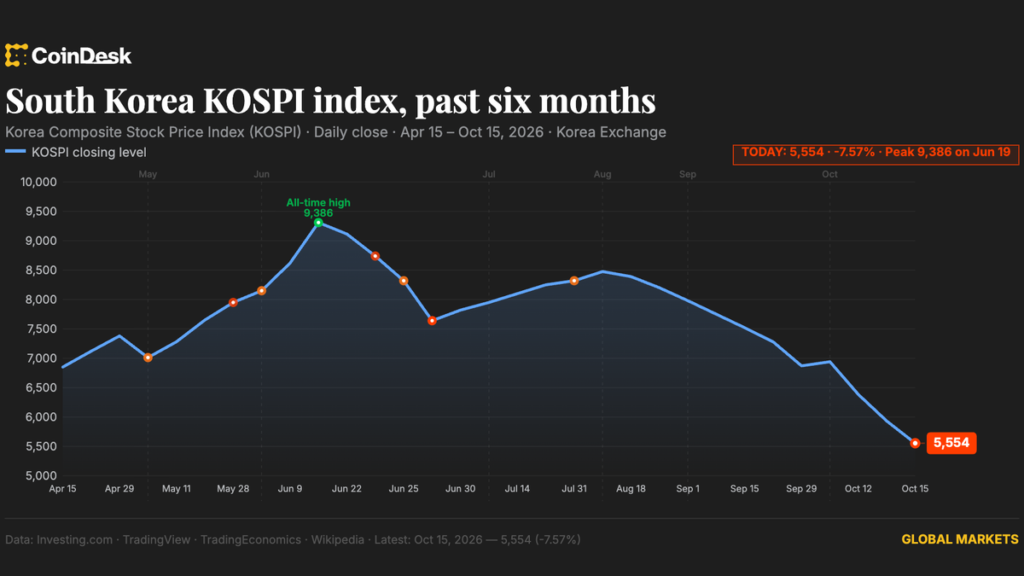
Ongoing apprehension across global equity markets is driving capital toward fixed income instruments, causing Western bond markets to rally significantly on Thursday.
South Korea’s Kospi now down 20% in seven sessions
The technology-heavy Kospi index, featuring giants like Samsung and SK Hynix, dropped an additional 7.5% overnight as Wednesday’s downward pressure in the United States rippled internationally.
Data compiled by Bespoke indicates that the Kospi has dropped 20% across the last seven trading sessions, marking its worst performance over a seven-day period since the coronavirus market crash in March 2020.
Even with this downturn, the Kospi remains ahead by 29% for the year.
Futures for the Nasdaq 100 are lower by 1%, though they have recovered slightly from their deepest troughs. S&P 500 futures show only a slight decrease, while DJIA futures have ticked upward by 0.3%.
Support is being delivered via a robust fixed-income rally. The yield on the 10-year U.S. Treasury note dropped another 10 basis points down to 5.088%. Earlier on Wednesday, following the swift consumer price index release, the 10-year yield briefly surged to 5.36%.
Bitcoin sits at $81,000, managing a slight recovery from its lowest points yet recording a 2.75% loss over the past 24 hours. Meanwhile, ether, solana, and XRP have posted declines between 4% and 5%.
Ether bounces from two-month lows
Ether has mounted a recovery to reach $2,360, climbing away from the $2,314 mark touched during the early hours of Thursday, which represented its weakest position since August 20 according to metrics from CoinDesk.
ETH has experienced a steep downward correction since surpassing the $2,800 threshold on September 21, with losses exceeding those of bitcoin.
The primary driver behind this relative weakness is likely elevated bond yields, which diminish the attractiveness of yield-bearing decentralized finance platforms—an ecosystem largely constructed on top of Ethereum.
The AI selloff continues led by CoreWeave
The contraction in artificial intelligence equities persists, spearheaded by CoreWeave which slipped 4% in pre-market activity following a sharp 15% tumble on Wednesday. Additional AI infrastructure equities are similarly facing downward pressure, with Cipher Digital CIFR falling 5%, TeraWulf WULF dropping 6%, and IREN IREN giving up 4%.
Bitcoin has been dragged below the $81,000 threshold, whereas gold appears to act as a principal beneficiary, gaining more than 1% to move back above $4,150 per ounce.
The U.S. Dollar Index has relinquished a portion of its gains but stays above 102. Treasury yields continue their downward trajectory, with the benchmark 10-year yield resting at 5.085%.
Market focus now shifts to the producer price index statistics scheduled for release within the hour. Median projections anticipate a 0.5% monthly advance alongside a 5.3% year-over-year climb. Given Wednesday’s elevated consumer inflation announcement, this upcoming metric carries heightened significance, with investors currently pricing in a 27% probability of a Federal Reserve interest rate increase during the October gathering.
Bitcoin slips under $81,000 after a hot CPI print and a deepening AI selloff
A stronger-than-projected U.S. inflation report briefly propelled bitcoin close to $84,000 on Wednesday before dragging it down to roughly $80,400 early Thursday. This level hovers just above the previous Thursday bottom near $80,430. Bitcoin changed hands under $81,000, representing a 2.6% decrease over a 24-hour window.
Core inflation, which excludes volatile food and energy components, accelerated to 2.6% compared to the 2.5% projection. Such elevated readings elevate the probability of an upcoming Federal Reserve rate hike, which typically strengthens the dollar and places downward pressure on alternative assets like bitcoin. The central bank’s next convening is scheduled for October 27–28.
Artificial intelligence stocks compounded the negative sentiment. Futures tied to the Nasdaq 100 slid 1.2% after Anthropic communicated to potential backers that its third-quarter revenue reached $16.8 billion, a metric indicating decelerating expansion.
ZEC paced losses across the digital asset sector, retreating 11% to roughly $1,100. Ether decreased by 5% to approximately $2,370, while U.S. spot bitcoin exchange-traded funds experienced outflows totaling approximately $261 million on Wednesday, based on figures from SoSoValue.
A daily session conclusion beneath $80,400 would invalidate the support level that buyers have successfully defended twice since the previous Thursday.
Originally published at https://www.coindesk.com/business/2026/10/15/live-updates-bitcoin-back-under-usd81-000-as-ai-selloff-worsens.