Reporting concluded on November 4, 2026, at 5:30 p.m. EST.
Artificial intelligence data center equities suffered the steepest declines following the success of several political contenders who campaigned directly against the industry.
Dow Jones Industrial Average rises over 3%, tracking toward strongest performance since April 2025
The Nasdaq pared back some of its earlier advances, trading higher by 1.75% as the final half-hour of the session approached.
Meanwhile, the Dow Jones Industrial Average advanced by 3.1%. If this performance is sustained, it will mark the Dow’s most successful trading day since April 9, 2025, per Bespoke data, when President Trump declared a 90-day suspension on tariffs introduced just days prior.
What drove the outperformance of the DJIA? It has quietly transformed into a megacap technology index, featuring Apple, Microsoft, Google, and Amazon as core holdings, each advancing between 4% and 7% today. Equities in the financial sector (such as JPMorgan and Goldman Sachs) and consumer goods (including Walmart and Procter & Gamble) also recorded sharp gains as petroleum costs and Treasury yields declined.
Contractions in shares of Nvidia, Caterpillar (acting effectively as a data center proxy), and Chevron weighed down the Dow.
Bitcoin retreated from its intraday peak of $81,000, settling just above the $80,000 mark and maintaining a 3% gain over the previous 24 hours.
Strategy’s STRC touches $100 briefly, positioning the firm for potential large-scale bitcoin purchases
After hovering close to its $100 par threshold over the past two weeks, Strategy’s high-yielding preferred equity asset STRC finally reached the milestone earlier this afternoon before dipping back by a single penny to $99.99.
Earlier coverage:
Strategy’s high-yielding preferred equity instrument STRC — which currently distributes its 12% annual dividend on a daily cadence — climbed to $99.98 during Wednesday’s early trading session.
An increase of two additional cents will return STRC to its $100 par value for the first time since May.
Should STRC achieve the $100 threshold, Michael Saylor and his executive team will transition from repurchasing the shares to issuing them anew, directing the capital toward additional bitcoin acquisitions.
As a reminder, Strategy utilized STRC to raise in excess of $10 billion for bitcoin purchases following its July 2025 initial public offering. However, since share repurchases commenced during the summer of 2026, Strategy has generated $0 from STRC issuances, instead deploying over $2 billion to buy back the asset.
Although Strategy has maintained modest bitcoin purchases in recent weeks, those acquisitions were funded through common equity sales or existing corporate treasury reserves.
Crude petroleum extends losses, sinking to lowest levels since summer months
West Texas Intermediate crude dropped nearly 8% during the session to trade at $88.50 per barrel, reaching its weakest valuation since the period preceding Labor Day. Brent crude experienced a comparable decline.
Both President Trump and Vice President Vance pointed to the conflict in Iran as the catalyst for the Democratic electoral landslide during yesterday’s midterm votes.
“We are going to end the war,” declared Senate Democratic leader Chuck Schumer. “We have some Republicans already who have joined us … the power of the purse [is] one of the ways of deterring a president who does war without the consent of the American people.”
Schumer’s statements echo those made by Nancy Pelosi following the Democratic Blue Wave of the 2006 midterms amid George W. Bush’s campaign in Iraq. Federal funding persisted for the remainder of that presidential term.
The contraction in petroleum valuations provided relief to the fixed-income market, where the 10-year U.S. Treasury yield fell 5.4 basis points to 4.895%. The 2-year yield dropped 3.1 basis points to 4.583%.
Midday market overview: Bitcoin stays above $80,000 while Nasdaq advances past 2%
Risk-on assets generally preserved their early advances around midday on the U.S. East Coast.
Bitcoin traded near its session peak, gaining 3.65% over a 24-hour window to reach $80,450. Ether ETH$2,422.62 advanced 6%, while XRP and Solana each climbed approximately 3.5%.
The Nasdaq registered a 2.15% increase, while the S&P 500 added 1.9%.
Artificial intelligence data center equities continued to bear the brunt of the previous evening’s Blue Wave outcome. Hut 8 HUT$48.96·Market Closed and Cipher Mining CIFR$6.5050·Market Closed both dropped over 20%, whereas CleanSpark CLSK$6.8050·Market Closed, Core Scientific CORZ$12.76·Market Closed, Galaxy Digital GLXY$13.98·Market Closed, and IREN IREN$21.72·Market Closed all declined by upwards of 10%.
TeraWulf WULF$11.69·Market Closed, Keel Infrastructure (KEEL), and Bitdeer (BTDR) experienced more moderate losses of roughly 4% to 5%, likely because their business operations have less direct concentration in Texas, which witnessed unexpected Republican defeats statewide, including the gubernatorial race.
The primary outperformers included megacap hyperscalers. Amazon, Google, and Microsoft each gained 4% to 6%, while Meta advanced 2.4%.
“If you slow down data centers you are essentially pulling up the drawbridge over the moat for these companies,” observed one financial commentator. “They already have compute, they win even more now.”
‘The reason we lost is the war’: Vice President Vance
Vice President J.D. Vance — frequently mentioned among potential contenders as attention shifts toward the 2028 Republican presidential nomination — shared his perspective via X on Wednesday morning regarding the previous night’s Democratic electoral sweep.
“The reason we lost is the [Iran] war,” Vance stated.
“If you’d like to argue it was worth it, that losing the Senate for the next 6 years was worth it, then do so,” he added. “But everyone knows why we lost. And any honest conversation about where we go from here must start there.”
Strategy’s digital asset accumulation mechanism approaches reactivation
Strategy’s high-yielding preferred equity asset STRC — currently disbursing its 12% annual payout on a daily basis — appreciated to $99.98 during early Wednesday hours.
An advance of two more cents will bring STRC back to its $100 par valuation for the initial time since May.
Should STRC attain the $100 mark, Michael Saylor and his leadership group will transition from share buybacks to fresh equity issuances, directing the capital toward increased bitcoin purchases.
Readers may recall that Strategy leveraged STRC to accumulate over $10 billion for bitcoin investments following its July 2025 public offering. Nevertheless, since share repurchases began in the summer of 2026, Strategy has raised $0 through STRC and instead deployed in excess of $2 billion toward buybacks.
While Strategy continued acquiring modest quantities of bitcoin during recent weeks, those funds originated from common stock offerings or internal treasury balances.
MicroStrategy shares rose 6.5% on Wednesday as bitcoin climbed to $80,500.
Uncertainty around elections dissipates, creating an opening for risk assets and a softer dollar
Market participants may encounter novel opportunities across equities and alternative risk-on assets as election-related ambiguity recedes, according to Joel Kruger, market strategist at LMAX Group.
Kruger noted that financial markets had largely factored in the electoral outcome beforehand, restraining the potential for dramatic price swings. Even substantial Democratic majorities would lack the legislative votes required to override a presidential veto, thus lowering the probability of radical shifts in economic policy.
With political volatility easing, Kruger perceives an opportunity for traders to acquire assets during pullbacks and reduce positions favoring a stronger U.S. dollar.
Sovereign bond yields might also decline as market participants scale back their forecasts for additional monetary tightening by the Federal Reserve past December.
U.S. ISM Services index decreases slightly but sustains healthy expansion levels
The Institute for Supply Management’s Services Purchasing Managers’ Index retreated to 54.5 in October, down from 54.9 in the prior period. Economists had anticipated a reading of 54.8.
The Prices Paid sub-component ticked down to 73 from 74, while the New Orders metric moved from 59.8 down to 55.9.
Because the survey relies on diffusion methodology, any score exceeding 50 denotes economic expansion, whereas a figure below 50 indicates contraction.
U.S. debt yields showed minimal reaction, extending modest downward adjustments as the 10-year Treasury return dropped 2.1 basis points to 4.928%.
Bitcoin targets $80,000 as equities rebound during early post-election trading
After sliding more than 2% overnight as the Democratic electoral sweep became apparent, the Nasdaq climbed 2.2% during Wednesday’s early session. The S&P 500 advanced 1.8%.
Microsoft, Apple, and Amazon spearheaded the megacap equities with gains ranging from 5% to 7%, while Nvidia traded flat.
Crude petroleum valuations fell sharply, with WTI crude dropping 2.8% to reach $93.45 per barrel.
Bitcoin extended its overnight advances, rising 3% to trade at $79,500. Ether ETH$2,422.62 added 4%.
Riot Platforms jumps 14% following announcement of $28 billion data center agreement
While various data center operators faced steep declines early Wednesday following the Blue Wave, Riot Platforms RIOT$15.39·Market Closed surged 14% following its disclosure of a 15-year lease contract valued at $28 billion with an advanced artificial intelligence laboratory for its complete campus located in Corsicana, Texas.
Riot projects annual net operating income exceeding $2 billion on average once the facility operates at full capacity.
The enterprise has liquidated 20,264 bitcoin during the initial nine-month period of the year to generate $1.5 billion for data center expansion, concluding the quarter holding 2,418 bitcoin.
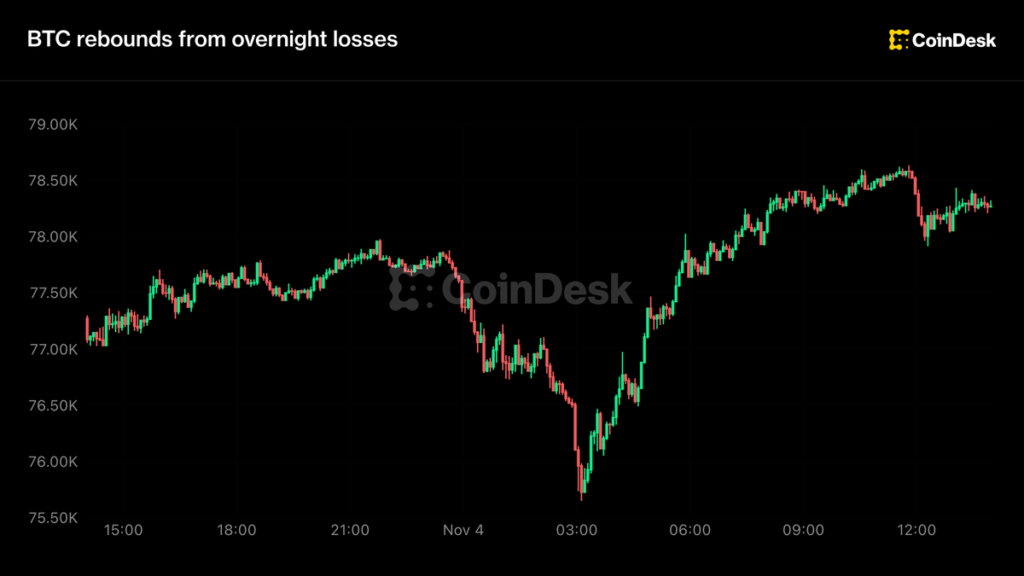
Bitcoin stages reversal from steep overnight drop
Bitcoin BTC$80,424.99 eliminated its early losses and climbed sharply as ambiguity surrounding the U.S. midterm elections diminished.
The foremost digital asset dipped just beneath $76,000 early Wednesday amid news reports suggesting Democrats were securing majorities in both legislative chambers of Congress, presenting a hurdle for pro-crypto President Donald Trump. Since then, it accomplished a V-shaped recovery, wiping out its initial losses to trade at $78,300 immediately prior to the opening bell on Wall Street.
This swift rebound highlights the reduction of uncertainty, according to Dick Lo, founder of TDX Strategies.
“Bitcoin dropped initially in response to the Democratic sweep of the midterm elections, but has since recovered as a clear outcome resolves political uncertainty,” Lo conveyed to CoinDesk.
Lo clarified that a Congress controlled by Democrats is generally perceived as less advantageous for pro-crypto regulation, though a divided government makes sweeping, market-disruptive policy overhauls highly improbable.
Nevertheless, President Trump retains the ability to “govern through executive orders while leveraging his veto authority to counter Democratic bills,” he added.
Nicolas Quatravaux, head of Europe, Middle East, and Africa at Paradigm, a prominent institutional liquidity provider for crypto derivatives, shared a comparable observation.
“The result itself wasn’t really a surprise. Polymarket had a Democratic win above 75% for a while. So overnight was less about the outcome and more about the uncertainty going away,” Paradigm noted.
He pointed out that overnight options market participants remained highly active.
“On election day we printed about $660m notional of BTC options blocks, more than double the day before. Roughly $420m of calls were bought vs about $105m sold,” Quatravaux stated.
A call option represents a financial wager on upward price movement, whereas a put option anticipates a decline. A block trade refers to a substantial transaction negotiated privately rather than executed on public order books.
Traders acquired $230 million in bitcoin call options, positioning themselves for a post-election market recovery. Near the valuation trough, other participants sold options to lock in protective hedges and capitalize on elevated market volatility.
Bitcoin was not unique in reversing its initial downturn, as Nasdaq index futures similarly entered positive territory after plunging over 2% overnight.
“With the results now confirmed, that uncertainty is gone, giving market participants confidence to re-enter the market. We’re also seeing the same price action on S&P and Nasdaq on Hyperliquid,” remarked Martin Lee, head of insights at DWF Labs.
October ADP employment figures rise by 86,000, surpassing forecasts
The ADP Employment Change report for October revealed that the private sector created 86,000 positions, retreating slightly from September’s total of 90,000 but beating economists’ median projection of 69,000.
The official government employment situation summary for October is scheduled for release on Friday, with analysts anticipating that the economy added 65,000 jobs during the prior month.
Artificial intelligence data center equities drop following Blue Wave results
“Data centers in space looking pretty appealing right now,” commented Elon Musk via social media overnight.
In various respects, the preceding evening’s midterm outcomes functioned as the “AI data center election,” and the results did not favor expectations.
Democratic electoral triumphs in states like Texas and Ohio — where data center expansion constituted a primary electoral topic — drove equities downward on Wednesday, contrasting with modest gains in broader equity indexes. Firms with heavy operational footprints in Texas experienced the most severe losses.
Cipher Digital CIFR$6.5050·Market Closed dropped 14%, Hut 8 HUT$48.96·Market Closed fell 10%, IREN IREN$21.72·Market Closed decreased 5.5%, CoreWeave (CRWV) lost 5.9%, and Bitdeer (BTDR) declined 6%.
Meanwhile, SpaceX SPCX$135.85·Market Closed fell 7.6% as Elon Musk faces potential regulatory probes, while Tesla TSLA$385.27·Market Closed retreated 5.3%.
Circle reports robust third-quarter performance as USDC transaction volumes surge
Circle Internet Group posted solid financial figures for the third quarter of 2026, highlighted by $13.9 trillion in onchain settlement volume for its dollar-pegged stablecoin USDC, representing a 49% expansion compared to the prior year.
Equities traded down 1.6% during pre-market hours.
Aggregate revenue and reserve interest income advanced 17% to reach $865 million, while adjusted earnings before interest, taxes, depreciation, and amortization jumped 85% to $317 million, supported by $182 million in proceeds from the private token presale of its new native network asset, ARC.
Despite a modest compression in its composite reserve yield percentage, the stablecoin issuer successfully boosted net income originating from continuing operations by 5% to $226 million.
The corporation debuted its public mainnet Arc on September 16, establishing a novel layer-one blockchain network that launched alongside over 100 institutional and ecosystem developers.
Circle also expanded its commercial footprint aggressively by executing an agreement to purchase Singapore-based cross-border business-to-business payments network Tazapay to strengthen its operational reach across Asia-Pacific and Latin America.
Originally published at https://www.coindesk.com/tech/2026/11/04/live-updates-bitcoin-and-stocks-reverse-overnight-plunge-following-blue-wave-landslide.