Back in April 2023, when bitcoin traded close to $30,000, CoinDesk highlighted China’s credit impulse as a positive driver for risk-on assets, including bitcoin (BTC).
That same metric is currently conveying an entirely different message.
Devised by economist Michael Biggs in 2008, the credit impulse gauges the variation in fresh credit velocity relative to gross domestic product, which tracks the complete output of goods and services within a nation during a specific timeframe.
Simply put, the gauge evaluates if fresh lending growth across an economy is accelerating or slowing against economic size, moving beyond just tracking total outstanding debt. An ascending credit impulse signals that fresh credit is entering the system at a faster pace, which typically stimulates demand and expansion, whereas a declining reading implies the opposite.
According to research from Societe Generale, this index matches global manufacturing trends and precedes S&P 500 performance by a full 12 months. This downward trajectory also signals trouble for raw material valuations, considering China acts as a premier global manufacturing hub and a top consumer of commodities.
As a natural absorber of liquidity, bitcoin is likewise tied to these movements. Historically, major price bottoms for bitcoin have lined up with recoveries in the credit impulse.
Societe Generale reports that the indicator is presently dropping, and overlooking this shift could prove costly for risk-oriented assets.
Societe Generale strategist Albert Edwards noted regarding the drop in credit impulse that ignoring China’s recent monetary tightening might become the major investment error of the decade.
He clarified that shrinking credit generation compared to GDP inside China could indicate an approaching worldwide economic slowdown, which might drag down corporate profits and American equity valuations.
Resilient BTC?
Data provider MacroMicro shows that the Bloomberg China Credit Impulse index raw measurement recently hit 20.84 points, marking its lowest level since 2008. Even so, bitcoin rallied 25% through August and climbed past $80,000.
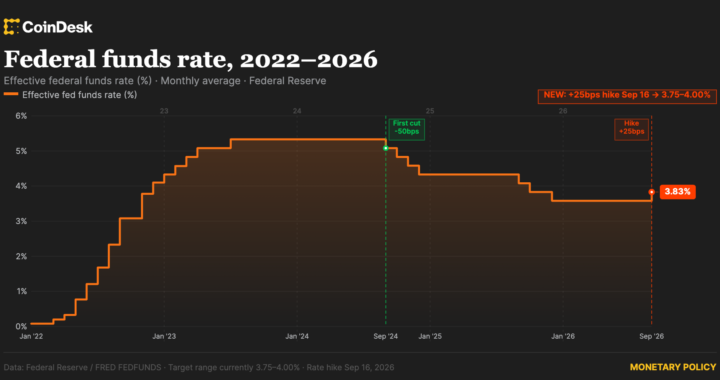
This surge featured heavy inflows into U.S. spot exchange-traded funds, the unwinding of short bets, and general momentum across sectors that lagged behind equities earlier in the year. More recently, the climb has stalled just beneath the $80,000 mark as renewed worries regarding Federal Reserve interest rate hikes dampen market sentiment.
Looking ahead, two potential paths emerge. In the first outcome, bitcoin keeps pushing upward, brushing off the cooling Chinese credit impulse. Such behavior would not shock observers given how market participants have evolved. Modern crypto trading is largely fueled by institutional flows from the United States rather than the retail volume from China and South Korea that initially defined the asset’s early days, potentially making bitcoin less reactive to metrics tied to mainland credit conditions.
The alternative outcome is considerably less reassuring.
Should Wall Street equities stumble, mirroring the warnings from Edwards’ credit impulse analysis, the resulting risk aversion could easily spill over into bitcoin regardless of where its investors happen to be located.
Which of these two trajectories will unfold remains uncertain.
Originally published at https://www.coindesk.com/markets/2026/09/02/a-china-indicator-that-greases-risk-taking-in-stocks-and-bitcoin-is-flashing-red.