Opinion by Lissele Pratt, co-founder, Capitalixe
Over the previous weekend, the Federal Bureau of Investigation asserted that North Korea orchestrated the $6.3 billion Binance breach, which industry analysts describe as the largest digital asset robbery on record.
Although I have encountered extensive coverage regarding the magnitude of this exploit, significantly less attention has been directed toward the aspects that functioned successfully.
Because while the wrongdoers unquestionably walked away with $6.3 billion, they have been unable to retain a major portion of those stolen assets, with $2.85 billion in funds having been frozen.
This outcome is primarily attributable to the composition of the stolen capital, as 94% of that $2.85 billion sum existed in the form of stablecoins.
Even though this security breach was broadly devastating, it demonstrated that centralized oversight, frequently condemned by digital asset maximalists, might serve as one of our most potent defenses against blockchain crime.
Unlike numerous other digital instruments, stablecoins feature the capability to be locked by their creators, providing targets of theft a genuine opportunity to prevent illicitly obtained currency from falling into undesirable possession.
Nonetheless, this introduces a troubling dilemma: if private corporations wield the authority to freeze billions in financial holdings, who determines the appropriate circumstances for deploying such power?
Great Britain now possesses the ideal moment to establish those exact parameters.
The race to get rid of stablecoins
To grasp the true significance of these asset freezes, one only needs to examine the actions taken by the threat actors within the opening sixty minutes of their attack.
Related: Binance, Polymarket seek Polygon hard fork to recover $6.8M in stolen crypto
They clearly recognized that a severely restricted window existed for transferring the stablecoins before intervention could occur, prompting them to execute those transfers immediately.
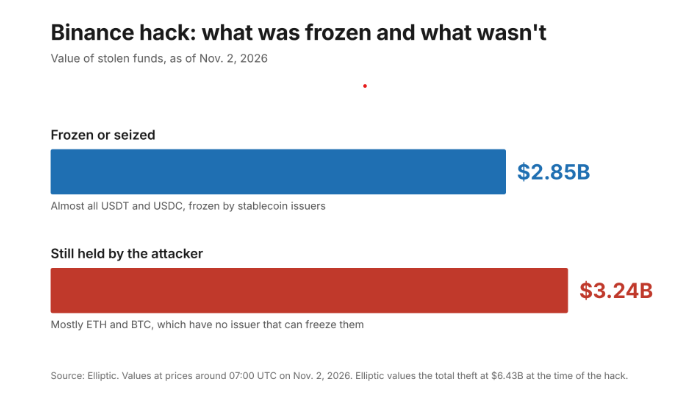
What was frozen from the Binance hack. Source: Elliptic
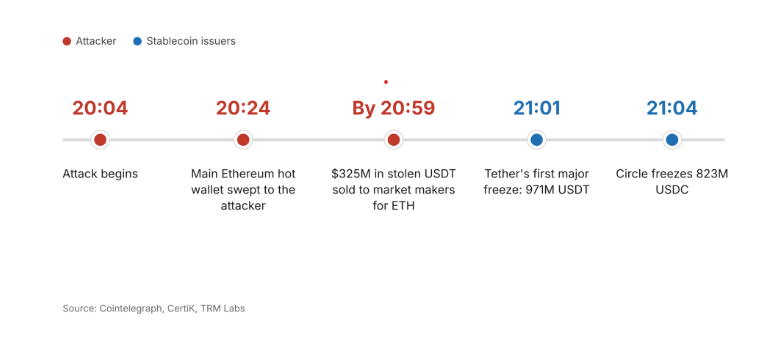
Scarcely an hour following the commencement of the exploit, they had already liquidated $325 million worth of stolen USDT (Tether’s digital currency) in exchange for Ether, motivated by the objective to trade a freeze-compatible asset for one that resists such actions.
Fortunately, stablecoin operators responded swiftly, with Tether initiating its primary asset freeze merely 37 minutes after the pilfered reserves hit the attackers’ central address, followed three minutes later by Circle blocking transactions involving USDC.
Without the swift interventions of Tether and Circle, a substantially larger volume of capital would have permanently slipped away.
We’re yet to agree on the rules
To their credit, these emergency freezes succeeded largely because a select group of enterprises chose to implement them dynamically in real time.
The underlying difficulty remains the absence of a standardized framework defining when asset freezing is legally justified or how rapidly entities must react, and the absence of these guidelines is generating visible fallout.
For example, Circle is currently confronting a proposed class action lawsuit brought by backers of Drift Protocol who contend that the firm omitted to freeze approximately $230 million in stolen USDC following the April exploit, arguing that Circle possessed the ability to halt the transfers but failed to move expeditiously.
Simultaneously, Tether faces legal action in New York filed by a pair of entrepreneurs alleging that the company locked millions of their funds months prior to the issuance of any formal seizure warrant, though it is vital to note that Tether has formally addressed this proceeding by labeling the claims groundless.
Operating within the banking and payments sector, I frequently observe traditional financial institutions place holds on funds and accounts, which might prompt the query: if conventional lenders routinely exercise this authority, why shouldn’t stablecoin issuers be afforded the same privilege?
Stablecoin freeze timeline. Source: CertiK
My contention is not that they ought to be barred from doing so. However, commercial banks do not arbitrarily decide to freeze accounts on a whim, as their actions typically require a legal catalyst alongside an established mechanism for appeal.
Stablecoin administrators now hold equivalent power while operating under tighter time constraints and across international boundaries, making it imperative that they receive proper structural oversight.
Britain can fix this
Nevertheless, a specific hurdle accompanies the regulation of stablecoin providers since Tether and Circle—two prominent market leaders—are not headquartered in the UK, meaning British regulators cannot issue direct mandates to them.
Related: Binance traces $6.3B hack to fake job interviews, compromised AI tool
Conversely, the UK government maintains authority over which stablecoins are permitted for purchase by domestic consumers, a process that has already commenced.
Last June, the Financial Conduct Authority (FCA) released its updated digital asset regulatory framework, which mandates that UK trading venues perform comprehensive due diligence and publish disclosure paperwork before listing any token, encompassing internationally issued stablecoins ahead of its October 25, 2027 enforcement date.
Furthermore, the Bank of England is concluding its Code of Practice targeted at systemic stablecoin operators by the close of the current year, addressing tokens whose adoption levels for payments carry systemic importance for British financial stability.
Neither regulatory structure explicitly defines obligations regarding the freezing of illicit funds in the manner I deem necessary, but because both policies are still evolving, the UK has an ideal opportunity to bridge this legislative gap preemptively rather than attempting to retrofit mandates later.
Two conditions for a UK listing
Consequently, I propose a viable remedy where any stablecoin must satisfy two prerequisite conditions prior to gaining authorization for sale on domestic UK trading platforms.
First, the issuing entity must remain accessible and prepared to take immediate action, matching the rapid response Tether and Circle delivered last week, while ensuring smaller British platforms receive identical operational support.
I collaborate with several modest blockchain enterprises that lack Binance’s prominent status or direct communication channels with Tether, leaving them most vulnerable to prolonged delays under current conditions.
Second, a well-defined schedule must govern subsequent procedures, meaning that if an issuer locks capital, it must notify the National Crime Agency before the day concludes, with the freeze automatically lifting should a formal court order failing to materialize to maintain the wallet restriction.
Neither of these proposals represents an overly radical stance, as they would simultaneously empower law enforcement to intervene during asset thefts and protect individuals from indefinite, legally unsupported account freezes.
The Binance security breach has highlighted that stablecoins provide targets of financial crime with a pathway to recover stolen resources before permanent loss occurs, a capability that should not remain exclusive to the planet’s largest trading venues.
Magazine: Can decentralized phone networks power the AI revolution?
Originally published at https://cointelegraph.com/opinion/285b-binance-hackers-lost-shows-why-uk-needs-stablecoin-freeze-rules?utm_source=rss_feed&utm_medium=rss&utm_campaign=rss_partner_inbound.