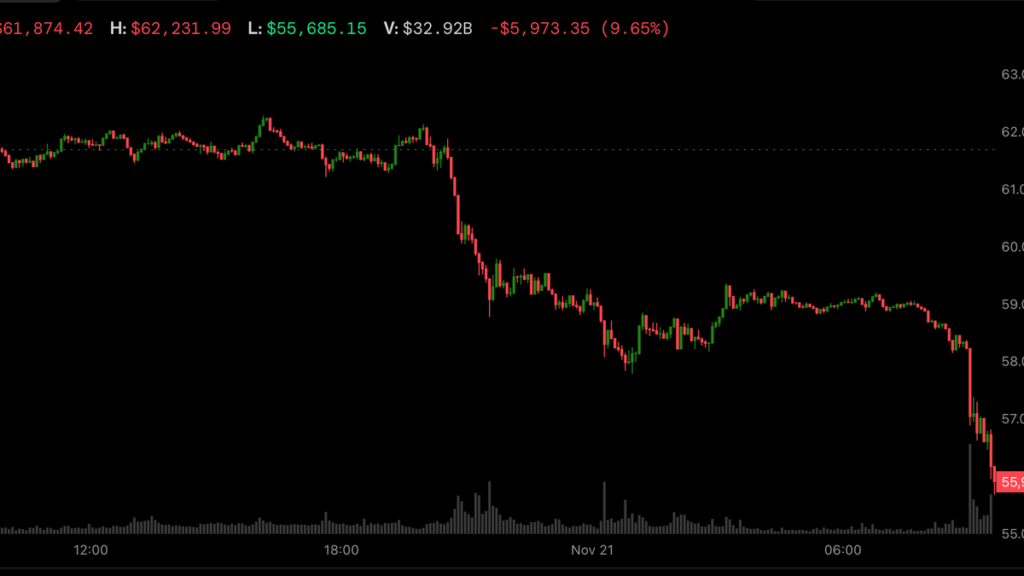
Bitcoin dropped under $57,000 on Friday, reaching its lowest point since September 2024 and further punishing risk-on assets.
This recent slump extends a severe bear market that kicked off following bitcoin’s peak past $126,000 in October of last year. Values subsequently dipped under $58,000 in June prior to a rebound that pushed them past their 50-week simple moving average in September—a development that led certain analysts to believe a fresh bull run had started.
Nevertheless, that positivity has since vanished. Bitcoin currently shows a 28% quarterly loss, and this latest slide has dragged it back underneath a threshold not seen in over two years.
The cryptocurrency is not experiencing this alone. Technology shares, gold, copper, and Asian stock markets have all suffered heavy losses throughout the week. The Nasdaq slumped in excess of 4% on Friday, hitting a trough not touched since April. Concurrently, gold retreated to its weakest price since September 2025.
Experts indicated that rising real, or inflation-adjusted, U.S. Treasury yields served as a primary catalyst for the decline. Elevated real yields increase the payouts offered by secure government bonds, diminishing the appeal of non-yielding holdings like gold and Bitcoin.
Consequently, heavy pressure has mounted on instruments relying on speculative demand and abundant liquidity. With the Federal Reserve pointing toward a tighter monetary stance, market participants are reevaluating the prices they are prepared to pay for equities, digital assets, and alternative long-horizon investments.
Liquidations surge
This rapid downward movement has inflicted damage on leveraged traders once again.
Figures compiled by Coinglass reveal that centralized and decentralized platforms liquidated roughly $2.40 billion in digital asset futures contracts over the preceding 24 hours. Bitcoin derivatives alone made up upwards of $1 billion of that aggregate sum, whereas Ether derivatives experienced $545 million in forced closures.
The biggest single wiped-out position involved a $51.71 million bullish bet on Bitcoin.
The magnitude of these losses highlights how heavily skewed bullish the leverage had become. The majority of traders anticipated a continuous bull market and failed to foresee Bitcoin sliding beneath the $60,000 mark.
Forced liquidations occur when a trading platform automatically closes out a leveraged position because the account holder lacks adequate margin to sustain it. During a declining market, this dynamic frequently creates a domino effect: dropping prices eliminate long positions, prompting mandatory liquidations that drive values further down and trigger subsequent rounds of closures.
Originally published at https://www.coindesk.com/markets/2026/11/21/bitcoin-tanks-below-usd57-000-for-the-first-time-in-two-years-and-its-not-alone.