Nov 8, 2026, 10:21 p.m. EST
3 min read
Summary
- Bitcoin tumbled down to roughly $73,761, marking its lowest point since August, prior to bouncing back above $75,000, while ether staged a recovery after sliding past the $2,100 threshold.
- CoinGlass reported that upwards of $1 billion in leveraged crypto positions faced liquidation over a 24-hour period, which encompassed $913 million in bullish bets.
- The market sell-off followed revelations of a probe concerning Nvidia’s chief executive alongside deadlocked U.S.-Iran discussions, with participants standing by for Monday’s traditional market reaction.
Bitcoin BTC experienced intense two-way swings over the past several hours, serving as a reminder to investors of the dangers associated with leverage.
This turbulence arose as the market absorbed two troubling developments. First, Jensen Huang, the CEO of AI leader and top market-cap stock Nvidia, confessed to having an affair with an individual whom U.S. authorities suspect of spying for China. Second, Secretary of State Marco Rubio announced that diplomatic discussions with Iran had broken down.
As the sole open market throughout the weekend, digital assets initially treated both events as risk-off catalysts.
The price action
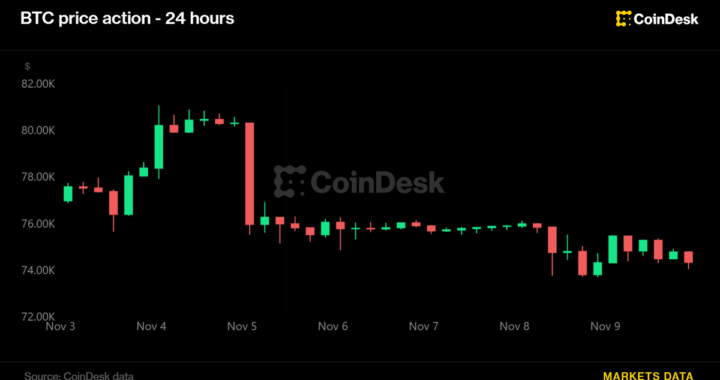
Late Sunday, bitcoin sank to about $73,761—its lowest level since August—before staging a rebound to trade above $75,000, according to CoinDesk data. Ether ETH, the second-biggest token by market capitalization, plummeted below $2,100 prior to recovering to $2,144 at the time of publication.
Such volatility triggered widespread forced liquidations across leveraged futures holdings.
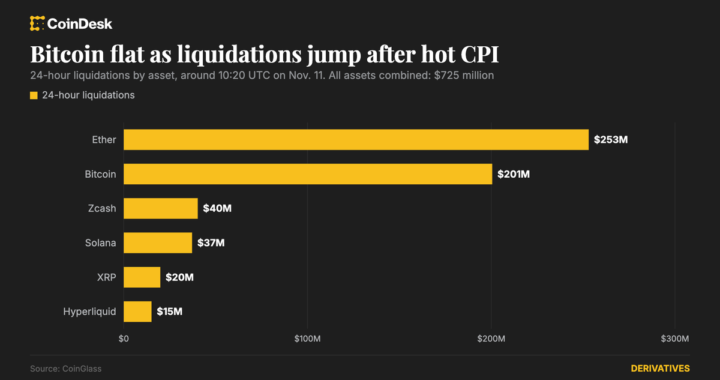
Data from CoinGlass indicates that cryptocurrency traders suffered over $1 billion in liquidations within a 24-hour window.
Long positions—speculators anticipating higher prices—made up $913 million of that aggregate figure, indicating that the market severely penalized participants positioned for upward momentum.
Ether suffered a more severe blow compared to bitcoin on a relative basis. It encountered $448 million in liquidations, nearly double bitcoin’s $272 million tally. Furthermore, the single largest individual liquidation order involved ETH and was valued at $48 million.
The Nvidia news
Nvidia’s board revealed it launched an independent review following reports that CEO Jensen Huang maintained a personal relationship with Alice Huang, a corporate executive suspected by American intelligence services of transmitting data to Beijing.
Jensen Huang confirmed the relationship in communication sent to staff, stating that he was unfaithful to his spouse and expressing regret for the ensuing fallout.
Nvidia stated that it possesses no evidence indicating national security or corporate secrets were compromised, though its investigation will scrutinize all accessible information. External independent counsel is supervising the review alongside the board of directors.
The implications stretch far beyond a personal controversy. Nvidia sits squarely at the epicenter of the artificial intelligence boom, a movement that has fueled speculative risk appetite across all financial sectors, including digital assets, in recent years.
Additionally, the corporation stands at the heart of the technological rivalry between the United States and China.
While Washington enforces restrictions on exporting Nvidia’s cutting-edge AI processors to China, Megaspeed—the firm connected to Alice Huang—has faced accusations of assisting restricted Chinese enterprises in acquiring Nvidia hardware.
Thus far, the tokenized equity market has reacted unfavorably.
NVDAX, the tokenized iteration of Nvidia shares traded on xStock, retreated 3.55% to $180.42 across the preceding 24 hours. Because the underlying Nvidia equity closed Friday’s Nasdaq session at $186.64, this ongoing discount signals that crypto market participants expect a steeper decline when conventional stock exchanges reopen on Monday.
Investors have lately grown skeptical regarding the longevity of the artificial intelligence narrative. Wall Street’s technology-focused Nasdaq index dropped nearly 5% during the prior week, marking its fourth consecutive weekly decline.
Iran adds pressure
U.S. Secretary of State Marco Rubio characterized Iranian demands as unacceptable while noting that negotiations failed to achieve progress, keeping Middle Eastern geopolitical friction elevated.
This dynamic matters greatly for the crypto sector because heightened regional friction typically drives up petroleum prices, fostering risk aversion. Despite its reputation as digital gold, bitcoin has frequently trended downward during crude oil rallies since the onset of the conflict with Iran in March.
What next
CoinDesk figures show that while the recovery to $75,000 offers optimism for bulls, momentum has already plateaued at the time of writing.
Whether current price levels hold will largely hinge on how traditional financial markets respond on Monday to the developments surrounding Nvidia and the situation with Iran.
Examining the technical charts, BTC currently hovers between support at the 200-day moving average near $73,150 and resistance at the 100-day moving average around $77,430.
Originally published at https://www.coindesk.com/markets/2026/11/09/bitcoin-drops-then-pops-as-nvidia-cheating-scandal-and-failed-iran-talks-trigger-volatility.