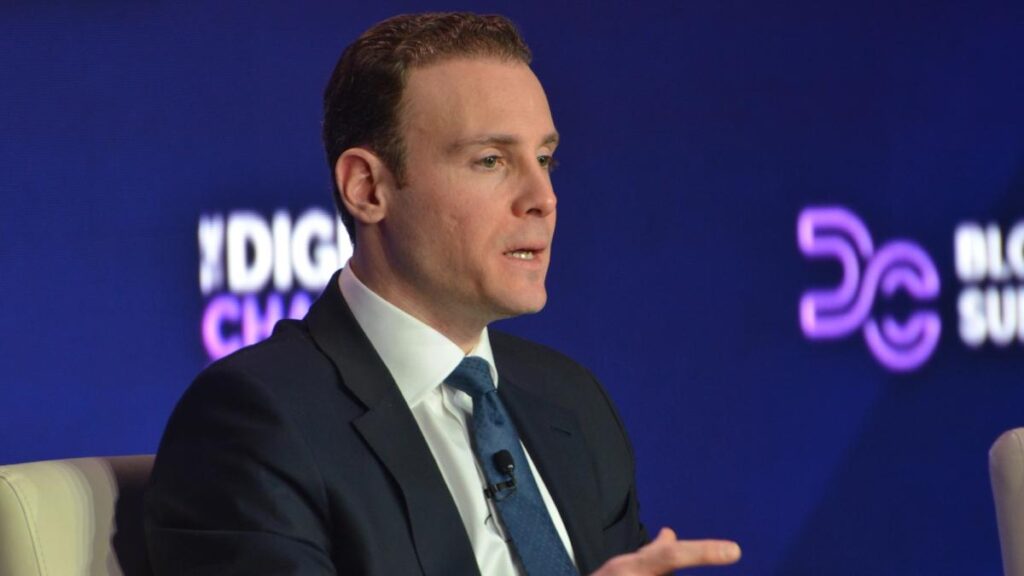
Cryptocurrency platforms like Hyperliquid are permitted to provide perpetual futures to American retail customers provided they secure regulatory authorization or collaborate with an authorized exchange, according to Commodity Futures Trading Commission (CFTC) Chairman Michael Selig.
During the Capitol Crypto Forum organized by The Hill and The Block in Washington on Thursday, he emphasized that decentralized applications must adhere to the identical guidelines governing standard derivatives markets, receiving no unique concessions for utilizing distributed ledger technology.
Selig stated that authorities will not grant different compliance obligations simply because an activity occurs onchain.
As an illustration of how digital asset firms can successfully enter the sector, Selig highlighted Backpack, a crypto exchange that recently acquired permission this week to run a domestic derivatives platform and clearinghouse, in addition to obtaining status as a futures commission merchant.
These remarks emerge while multiple organizations actively endeavor to introduce Hyperliquid-anchored trading to the United States via compliant frameworks, despite the underlying decentralized exchange remaining inaccessible to domestic participants.
Payward, the parent company of Kraken, declared in September its intention to facilitate perpetual futures trading via the CFTC-registered Bitnomial Exchange utilizing the Hyperliquid network, pending regulatory clearance.
More recently, and likewise awaiting authorization, HypeStrat Markets—a subsidiary of the Hyperliquid treasury firm Hyperliquid Strategies—filed an application to operate as a registered futures commission merchant, which could enable U.S. traders to access markets built on Hyperliquid.
Hyperliquid has previously faced scrutiny from prominent American exchange administrators. Intercontinental Exchange and CME Group urged regulators in May to investigate potential market manipulation and sanctions infractions on the network. Neither the CFTC nor the SEC has initiated public enforcement actions against Hyperliquid.
Separately, the Securities and Futures Commission (SFC) of Hong Kong incorporated Hyperliquid into its directory of questionable virtual asset trading platforms on Wednesday, noting that it lacks a license and is suspected of soliciting or conducting business with investors in Hong Kong.
The broader digital asset industry continues to experience regulatory uncertainty following the failure of federal lawmakers to pass a comprehensive market structure bill earlier in the autumn.
The Clarity Act was defeated in the Senate by a 49-50 margin during September. Ever since, both the CFTC and the SEC have pursued independent rulemaking initiatives, though neither body can fully replicate the extensive legal parameters previously drafted by Congress.
Following that legislative stall, the SEC introduced exemptions tailored for specific tokenized-equity platforms, whereas the CFTC forwarded its proposed digital asset guidelines to the White House for evaluation.
Although Selig did not explicitly address the Clarity Act, he firmly asserted the CFTC’s preference for maintaining digital asset transactions domestically under federal supervision rather than forcing activity into international jurisdictions.
He noted that these financial activities will occur regardless, and the primary question is simply their geographic location, warning that failing to accommodate them domestically will only drive them overseas.
Furthermore, Selig defended the agency’s choice to permit perpetual futures linked to individual equities, maintaining that their periodic funding distributions function similarly to mechanisms found in traditional futures agreements.
This determination has encountered a legal challenge from the Capital Markets Alliance, an association supported by legacy financial institutions contending that these financial instruments fall under the regulatory purview of the SEC.
Selig remarked that certain participants dislike encountering competition from these perpetual instruments, particularly after maintaining a monopoly or near-monopoly over equivalent offerings historically.
He additionally acknowledged pushback originating from digital asset enterprises advocating for minimal oversight.
He concluded that while this stance might displease individuals in the cryptocurrency sector desiring total deregulation, maintaining such an approach would be unfair to legacy participants who have historically adhered to established standards.
Originally published at https://www.coindesk.com/markets/2026/11/20/cftc-tells-hyperliquid-and-crypto-rivals-no-special-rules-for-onchain-trading.