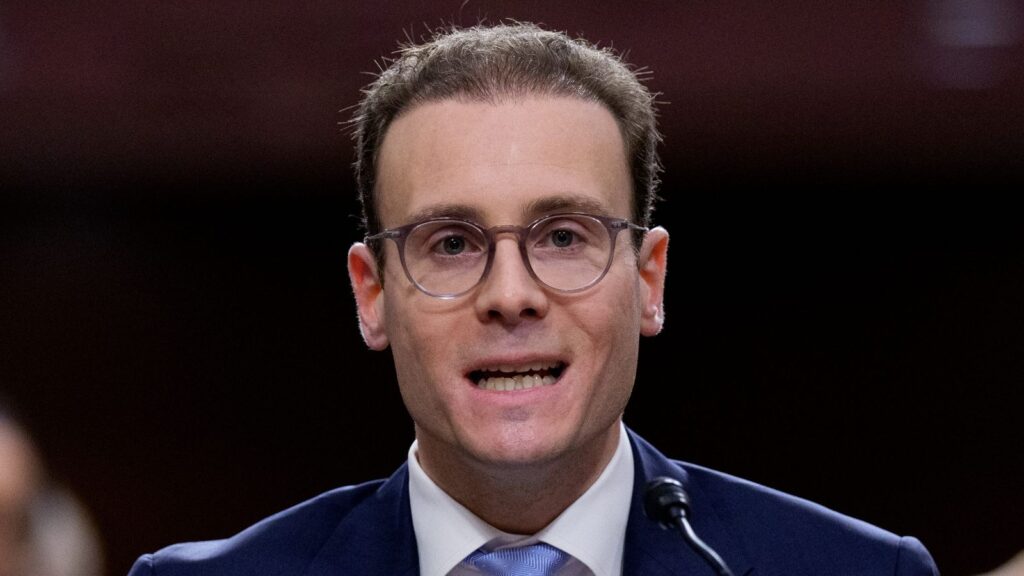
Michael Selig, Chairman of the Commodity Futures Trading Commission, explained that cryptocurrency onchain networks hoping to supply derivatives to retail participants in the United States may either seek independent exchange registration or collaborate with an already authorized entity.
When questioned on how a decentralized platform like Hyperliquid could legally operate within the U.S. during a Thursday interview at The Hill and The Block’s Capitol Crypto Forum, Selig referenced Backpack. Backpack secured three licenses earlier in the week to facilitate its entry into the American market, representing the first method. Alternatively, Selig noted that several platforms are actively pursuing alliances with compliant entities.
“You’re going to have to come in and partner with an exchange or obtain your own exchange, which doesn’t change the ability and the great features of crypto and blockchain,” Selig stated.
The trio of licenses obtained by Backpack encompasses a Futures Commission Merchant authorization, a Designated Contract Market designation, and a Derivatives Clearing Organization status. Backpack commented earlier in the week that “Together, the three licenses provide the full regulatory stack for Backpack’s U.S. entry, the first by a crypto-native exchange offering leveraged perpetual futures with global unified liquidity.”
Selig emphasized that while networks are free to continue utilizing onchain infrastructure, they must still adhere to the identical compliance standards governing traditional exchanges.
Prediction markets and state challenges
Selig also mentioned that the CFTC intends to cooperate alongside the Department of Justice whenever state authorities initiate legal actions against federally permitted platforms to dispute the agency’s oversight authority. The federal government and the CFTC jointly filed a lawsuit against Utah in October, and the regulatory body launched distinct legal challenges against Arkansas as well as Louisiana on November 13.
“If it’s a legal and lawful derivative, it should be regulated by the market regulator. It’s not something that goes to the state,” Selig remarked.
Differentiating derivatives exchanges from gambling houses and state-sanctioned gaming establishments, Selig asserted that the CFTC has no jurisdiction over the latter category. Regarding event contracts, Selig explained that the regulator evaluates whether they function as derivatives and comply with governing standards, including vulnerability to manipulation. He pointed out that the commission’s draft Rule 40.11 outlines the specific public policy metrics it will weigh when assessing these agreements.
Selig on single-stock perps
Selig argued that the lack of a defined expiration date on a single-stock perpetual contract does not automatically transform it into a security-based swap. He emphasized that the structural design of these instruments is what counts, drawing a parallel between daily funding transactions and variation margin payments common in other futures products.
“It doesn’t have an expiration date. And so there’s what’s called a funding rate, where payments are exchanged on a daily basis,” Selig explained. “This is very similar to variation margin with other types of futures contracts. But they’re structured as futures contracts; they’re not structured as a swap or as a security-based swap.”
Originally published at https://www.theblock.co/news/regulation/2026-11-19-cftc-chair-selig-hyperliquid-onchain-venues-the-us-444106.