A fresh security framework introduced by Phylax aims to help decentralized finance protocols block malicious transactions prior to their final settlement.
While this could strengthen the digital asset ecosystem against United States-sanctioned individuals and North Korean hackers, it might also enable a mechanism to freeze smart contract operations without explicitly granting that authority to any single party.
Such potential control generates worries that the platform could transform into a centralized instrument for law enforcement rather than supporting decentralized finance.
Stefanie Boss, co-author of an academic study regarding censorship resistance and compliance protocols within Ethereum’s consensus architecture, notes that the dilemma centers on acceptable versus existing risk.
She mentions that she considers it an acceptable risk in this instance because the primary objective is to enhance network safety and align more closely with application and network values.
A security mechanism with a potential freeze risk
Unveiled on November 10, the integration between Phylax and block builder Titan Builder enables Ethereum applications to establish specific criteria that filter out transactions likely to cause harmful effects during the block creation process.
Titan, which according to Phylax generates one out of every two blocks on Ethereum, evaluates transactions against these predefined rules prior to adding them to its blocks.
The goal is to stop exploits before they settle instead of depending on post-attack emergency responses or continuous monitoring tools. The official announcement stated that their mission is to prevent users from losing capital to DeFi bugs and hacks.
Related: Fears of AI-driven DeFi hack epidemic overstated for now — but not for long
In a published blog post, Phylax highlights a scenario involving a vulnerable vault that might accidentally disburse $1 million to someone whose shares are only valued at $1,000. With this setup active, a circuit breaker could restrict the payout volume in a single transaction, stopping the vault from being completely drained.
Comparable protections might likewise reduce losses during significant incidents like the $6.3 billion Binance hack or the $380 million Bitget exploit, where attackers emptied exchange accounts and transferred substantial amounts of digital currency through decentralized applications.
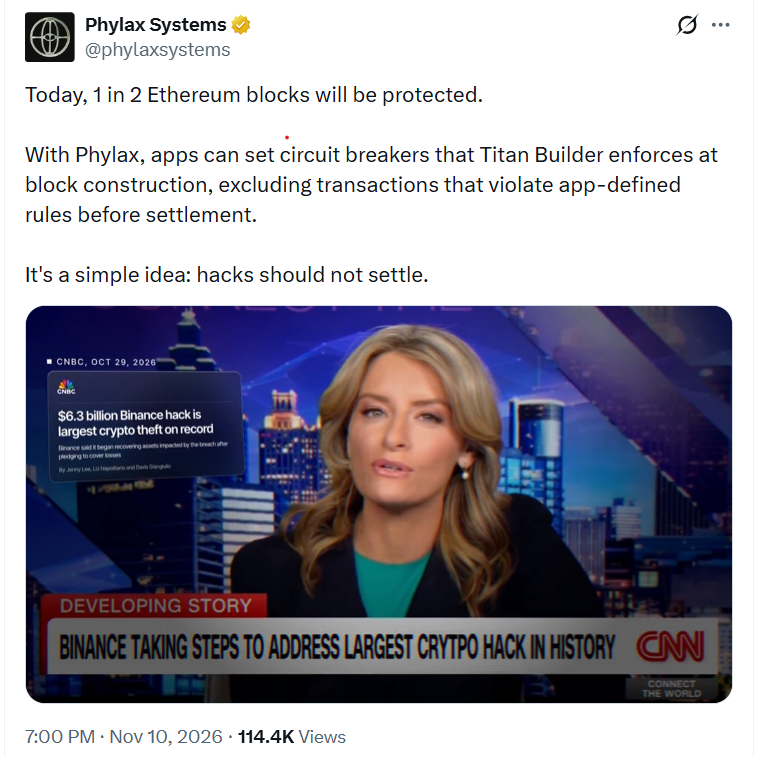
Phylax says hacks should not settle. Source: Phylax Systems.
Although blocking harmful transactions represents a victory for the cryptocurrency industry, blockchain attorney Gabriel Shapiro cautioned that protocols adopting the technology could become effectively susceptible to freezes if block builders halt delivery of the required attestations.
He clarified that smart contracts can be programmed to reject transactions unless they arrive via builders that completed the mandatory security validations. Should those builders stop supplying attestations, the secured functions would continually decline transactions until normal operations resumed.
Related: DeFi TVL drops 39% in 2026 amid market downturn and record hack activity
Odysseas Lamtzidis, founder and CEO of Phylax, counters that protocols can mitigate this hazard by allowing transactions to proceed even if the security validation tools remain offline.
He informed the publication that the sensible default configuration they supply and recommend to protocols is a fail-open mechanism.
Nonetheless, that safety measure remains optional, leaving individual projects to determine the balance between security and availability. Lamtzidis points out that certain protocols might elect to prioritize safety over liveness.
He additionally mentions that protocols retain the choice to keep their smart contracts immutable or permit modifications through governance mechanisms.
Shapiro asserts that fail-open safeguards ought to be compulsory and any alterations to these protections should incorporate time delays to stop protocols from instantly stripping them away.
Ethereum’s builder concentration problem
Another major worry involves whether this architecture might reinforce the already severe concentration within Ethereum’s block-building market.
Ethereum investigator Fan Zhang notes that Phylax’s innovation is only becoming viable today because of that exact concentration, stating that while they finally have a practical implementation method, it unfortunately relies on how centralized the builder ecosystem has turned.
Zhang states that the methodology proposed by Phylax brings attractive security advantages, particularly given that artificial intelligence bots discover vulnerabilities faster than ever.
Still, he cautions that embedding additional code at such a sensitive juncture of transaction processing introduces fresh points of failure, such as implementation flaws along with the theft, misplacement, or impersonation of builder signing keys.
He adds that because the community worries deeply about centralized builders and actively tries to fix the issue, he fears these distinct efforts might work against each other.
Related: FBI blames North Korea for record $6.3B Binance hack
Sen Yang, another Ethereum researcher, told the publication that if leading protocols depend on a restricted group of builders to enforce security, it could grant those specific builders a competitive edge and worsen overall market concentration.

Phylax announces its circuit breaker system. Source: Phylax Systems
He explains that the forthcoming enshrined proposer-builder separation upgrade on Ethereum, scheduled for the upcoming Glamsterdam network update, may cut down reliance on third-party relays, but it fails to directly tackle builder market centralization.
Yang notes that transactions dropped by dominant builders can still find inclusion via non-censoring builders, which may introduce processing delays instead of permanent exclusion.
Where does security become censorship?
Phylax contends its framework does not create a novel regulatory body over Ethereum transactions because the applications themselves formulate the conditions, emphasizing that the technology is strictly opt-in.
Lamtzidis draws a parallel between these checks and conditions already embedded within smart contracts, asserting it resembles a standard require function and that true censorship requires arbitrary coercion or decision-making.
Zhang draws a similar line between applications voluntarily choosing to filter transactions versus external entities enforcing censorship, explaining that voluntary filtering is acceptable because users can simply leave those apps, whereas externally imposed censorship remains the core issue.
Boss suggests that rules focused on a transaction’s outcome carry fewer concerns than those targeting the identity of the sender, noting that result-driven logic is typically viewed as less hazardous.
She deems the security objective valid, arguing that the damage caused by those exploits far outweighs the damage resulting from this form of exclusion.
Nevertheless, she cautions that these rule sets might also be leveraged to enforce sanctions or politically driven exclusions.
She concludes that ensuring proper safeguards exist to keep these rules impartial and focused entirely on security remains vital.
Magazine: Banks are banning AI agents over security… and competition concerns
Originally published at https://cointelegraph.com/magazine/ethereums-new-defi-security-tool-raises-questions-over-censorship?utm_source=rss_feed&utm_medium=rss&utm_campaign=rss_partner_inbound.