Senator Cynthia Lummis expressed clear frustration the day before the U.S. Senate rejected the Digital Asset Market Clarity Act. She addressed an audience at a Washington crypto conference, noting that she had spent over five years—most of her senatorial career—developing the bill.
Lummis, who plans to retire soon, already understood that the situation was deteriorating. She and fellow Republicans presented what they called their final proposal, featuring further concessions to Democrats, such as another pledge from President Donald Trump to accept unprecedented ethical limits on his cryptocurrency assets. Nevertheless, Democrats rejected the offer and introduced additional demands.
Conversely, Democrats viewed the proposed legislation as nearly identical to previous versions, maintaining that Trump could still sidestep accountability regarding conflicts of interest tied to managing a digital asset empire while simultaneously guiding its regulatory oversight. Although this concern was separate from the bill’s fundamental crypto market structure rules, it became the focal point of their opposition.
"The president should not be able to use the power and influence of his office to benefit his own crypto holdings while his administration makes decisions that could directly affect their value," stated Senator Mark Warner, a Democratic contributor to the bill’s illicit finance provisions who expressed a desire to support it. "At a minimum, any serious crypto legislation must include meaningful ethics requirements that prevent the president and other senior government officials from profiting off the policies they oversee."
However, Democrats insisted they were attempting to sustain negotiations until the final moments, only to be rebuffed by Republicans who terminated discussions and pushed for a vote. (Republican leaders could have delayed Tuesday afternoon’s vote if they believed ongoing negotiations remained viable.)
"Just as Democrats and Republicans were making progress to address ethics concerns, Republican leadership ended talks and forced a vote," remarked Democratic Senator Ruben Gallego following Tuesday’s vote. "They were never serious about bipartisan negotiations."
Senate Minority Leader Chuck Schumer shared similar remarks with reporters on Tuesday.
"As you may have heard, there was a bipartisan deal on the table as recently as this afternoon to resolve all outstanding items including ethics," Schumer said. "Republican leadership walked into the room, broke up the bipartisan discussion and said, ‘No, we’re done’ and killed it."
Democrats step back
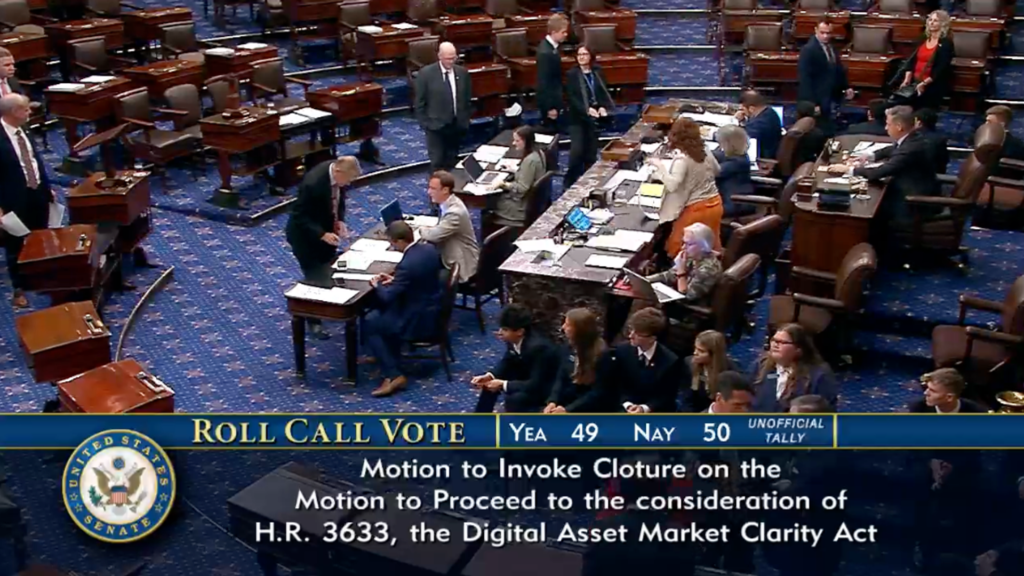
Consequently, Democrats—including longstanding supporters of the crypto bill like Senator Kirsten Gillibrand—withdrew their support, yielding a meager total of 49 favorable votes. This fell 11 votes short of the 60 required to clear the procedural hurdle for the legislation.
Lummis countered that the counter-proposal delivered by Democrats on Monday essentially mirrored the stance they held prior to the Senate’s August recess.
In a post-vote statement, she criticized the Democrats, labeling them "anti-American," despite a few opposing votes originating from her own party members.
"This afternoon, Senate Democrats proved they were never truly serious about protecting consumers and preserving American leadership," she declared. "I sat at the table with Senate Democrats working in good faith to get this done while they played games."
Throughout its journey, the Clarity Act faced continuous setbacks and strict deadlines. When a prior iteration neared approval within the Senate Banking Committee, Coinbase CEO Brian Armstrong withdrew his support over the bill’s treatment of stablecoin rewards programs. Coinbase’s opposition stalled the bill’s progress, triggering weeks of delay before it secured committee backing.
When legislative discussions resumed, the congressional session was nearing its end, with lawmakers and lobbyists fully aware that an upcoming election would complicate future bipartisan cooperation. Throughout the process, ethics remained the central debate requiring resolution before other components could advance.
During these discussions, President Trump agreed to concessions on two occasions, featuring a second round of modifications over the weekend. Yet, according to comments from Gallego, a primary Democratic negotiator on this matter, those changes fell far short.
"All President Trump wants is for the Senate to give him time to crime, and I won’t support any piece of legislation that enables him," the Arizona senator stated.
Throughout the negotiations, Gallego and other Democrats had to distance themselves from Senator Elizabeth Warren, the senior Democrat on the Senate Banking Committee, who strongly opposed the Clarity Act. She maintained her stance, consistently highlighting the digital asset ties between Trump and the industry that generated over a billion dollars for him during the first year of his second term.
"I believe we can get crypto legislation that both Republicans and Democrats can agree on. But not this bill," she stated on the Senate floor on Tuesday. "This bill will turbocharge Donald Trump’s unprecedented corruption."
Aside from the ethics controversy, the most contentious issue involved whether the measure would curtail stablecoin rewards capable of competing with traditional bank deposits. This aspect provoked Republican opposition, including a vote against the bill by Senator Josh Hawley of Missouri, who indicated last month that he opposed the legislation.
Lame duck session
This week’s defeat does not prevent lawmakers from pursuing a much more challenging initiative during the upcoming "lame duck" congressional session, spanning the four weeks between the election and the winter holidays. Republican Senator John Kennedy informed reporter Eleanor Terrett that the measure could resurface during that window.
Overall, the industry’s legislative achievements for this congressional session vastly exceeded any prior performance. Last year, it successfully passed the Guiding and Establishing National Innovation for U.S. Stablecoins (GENIUS) Act, which regulates stablecoin issuers and secured strong bipartisan backing. Furthermore, the Clarity Act performed admirably by passing the House of Representatives and reaching a Senate floor vote, representing unprecedented advancement for market structure legislation.
The House, where momentum for market structure reform has consistently been strongest, refuses to surrender following the Senate’s setback. The chairmen of the House Agriculture Committee and the House Financial Services Committee released a joint statement on Tuesday affirming their continued support for congressional action while committing to collaborate with regulators in the interim.
"The House has worked across multiple Congresses to establish a functional digital asset market structure framework for the digital asset ecosystem," they stated. "Until statutory certainty is achieved, we look forward to partnering with the federal financial regulators as they utilize existing authorities to develop rules and issue guidance governing digital assets."
Meanwhile, the Democrats who voted against the measure will enter the closing weeks of the midterm election season criticizing the president’s digital asset activities, while Republicans will accuse Democrats of stifling American innovation—all while anticipating that political funds from the crypto industry will deploy millions against their adversaries.
Originally published at https://www.coindesk.com/news-analysis/2026/09/15/there-were-many-conductors-in-the-derailment-of-the-crypto-industry-s-clarity-act.