Back in 1915, Kazimir Malevich placed a black square upon an exhibition wall, declaring it the foundational zero point of painting—the termination of imagery displayed as an image itself. More than a century afterward, that monochromatic shape re-emerges in Remains, serving this era as a direct outcome rather than a manifesto. Should the acquirer of one of these creations by the artist Rupture choose not to act, the blockchain system will automatically generate the black square on their behalf, pixel by pixel, block by block, until the visual disappears entirely.
Remains comprises a collection of four hybrid creations where a physical canvas and an associated ordinal inscription are structurally interconnected. Every individual inscription is composed of precisely 210,000 pixels—matching the total count of blocks mined throughout a single Bitcoin halving cycle. Starting at the forthcoming halving scheduled for April 2028, each inscription will undergo progressive decay in real time: a single pixel vanishes for each block validated across the network. Halting this degradation requires locating an alphanumeric key concealed beneath the surface of the physical painting—accessible exclusively by mutilating a substantial section of the canvas—and subsequently inscribing that key as a child ordinal to permanently stop the loss. If one chooses to protect the canvas, the digital image on the ledger will be erased. If one chooses to preserve the inscription, the physical piece is scarred permanently. Passive ownership is impossible for the collector. Choosing not to intervene is an active determination, and the Bitcoin network ensures that either choice becomes indelible.
The history of art contains numerous instances where destruction serves as an expressive act. Back in 1953, Robert Rauschenberg wiped out a drawing by Willem de Kooning, putting the empty surface into a frame. Banksy directed his work Girl with Balloon through a mechanical shredder built into its frame right as the Sotheby’s auction concluded. Furthermore, during 2016 at the Guggenheim, Sun Yuan and Peng Yu placed an industrial robotic arm inside an enclosure with just one assignment: continuously sweep a pool of blood-red fluid back toward its foundation, an endless cycle of self-preservation carried out over three years before it visibly slowed down and stopped. Can’t Help Myself may well represent the most melancholic machine ever constructed. It also stands as an immediate predecessor to Remains: each project depends on a ticking clock, forcing viewers to observe decay happening progressively. Yet while the machine’s conclusion was dictated by code, Remains keeps its resolution undetermined. In this instance, destruction is not a stage trick presented by the creator. Rather, it becomes a stewardship obligation imposed upon the owner.
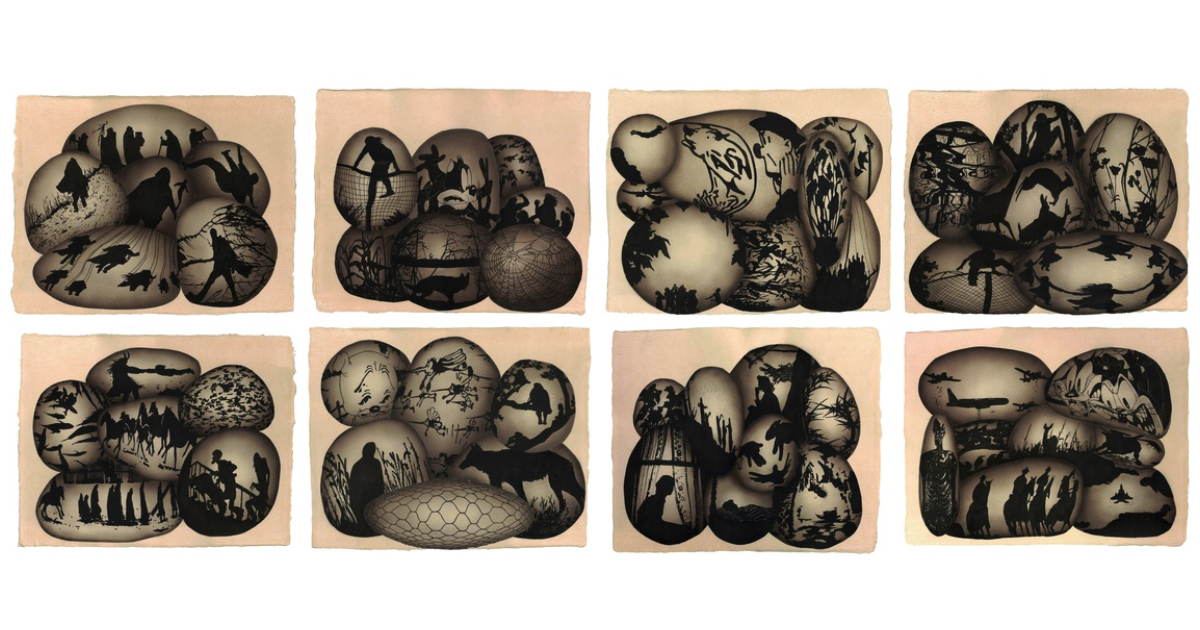
Rupture (born 1993 in Switzerland) is an autodidactic visual artist residing in Mexico City. Across the digital art ecosystem, he developed one of the most extensively acquired artist-created bodies of work on the Bitcoin network, the Persona collection (750 pieces spanning 2024–2025), alongside earlier creations on Ethereum; he was likewise an early pioneer releasing work across Solana. His physical studio background spans even longer: presenting work globally since 2016, including showcases at Museum Halle Saint-Pierre in Paris, Art Basel Miami, Belgrade’s 2nd Triennial of Self-Taught Visionary Art, alongside earning a nomination for the Prix Suisse d’Art Brut, crafting figurative canvases defined by dense, meticulous linework and a focus on permanence. Remains marks the intersection of both disciplines: uniting painting and the blockchain into unitary works, where neither part is complete without the other.
Bitcoin stands as the most defining system of permanence created within the modern era. Its fundamental design operates on the premise that whatever gets written down cannot be erased. Remains engages that premise directly to evaluate its boundaries—and by doing so, confronts an essential contradiction between material and digital culture: the material realm naturally degrades, while the digital ledger preserves permanently without regard to intent.
I met with Rupture prior to the opening to discuss entropy as an artistic instrument, the owner as an unwitting participant, and the required sacrifice behind preservation.
BMAG: Let’s start with the mechanism, because it’s the basis of the whole series. Each digital component contains exactly 210,000 pixels – the number of blocks in a Bitcoin halving epoch – and beginning at the April 2028 halving, one pixel dies for every block the network mines. Discuss how you arrived at that structure. Did the concept come first and the math followed, or did the number 210,000 suggest the work?
Rupture: The underlying idea was established prior to the creation of any individual piece. I was meditating heavily on permanence, particularly as it relates to digital channels. Bitcoin is commonly regarded as the most enduring and immutable ledger ever designed by human beings, and Ordinals were promoted using that exact value proposition—a genuinely everlasting data layer, contrasting with NFTs hosted on alternative networks subject to dead URLs and off-chain file storage. Persona, which was my initial Ordinals collection, embraced that assurance. With Remains, my goal was to subvert that premise completely.
To me, there is profound beauty found in impermanence. We currently exist in an era where concepts like transhumanism aim to engineer away mortality, and while I comprehend that ambition, my stance is quite the reverse: existence would be stripped of purpose were it everlasting. A similar rule applies to the arts. Monks in Tibet dedicate weeks to assembling an intricate sand mandala only to sweep it away—the act of dispersal constitutes an essential element of the creation.
Consequently, my objective was to construct a digital artwork intended to be eroded by Bitcoin’s internal rhythm. Following that logic, the framework came together organically. The most accurate on-chain equivalent to a dying pixel was the addition of a new block—an isolated, unalterable occurrence unfolding roughly every ten minutes without end. Thus, I tied them together directly. Since one epoch totals 210,000 blocks, the digital visual necessarily required 210,000 pixels. The numerical structure emerged from the foundational idea.
BMAG: The “kill switch” is hidden beneath the paint on the physical painting. To retrieve the code that stops the decay, the collector has to destroy a meaningful portion of the physical work – and then inscribe it as a child of the Ordinal. Did you paint these differently knowing the surface is also a type of vault? It’s very taboo to touch (or cut) a painting (outside of Lucio Fontana).
Rupture: I attempted to execute these compositions just as I would handle any standard canvas. The sole distinction was having to begin with the alphanumeric key. Each code was transcribed onto paper, sealed within lamination, and affixed directly to the center of the wooden support underneath coatings of modeling paste and gesso. Only following that process could the painting take shape. Consequently, the hidden code forms the absolute foundation. Every subsequent brushstroke rests over it.
Regarding the cultural taboo—I believe the majority of people, myself included, are naturally inclined to attach far greater significance to a material artifact. The tangible canvas feels irreplaceable in a manner that the digital inscription does not, even though the on-chain element might possess greater scarcity. That ingrained mindset is precisely what gives the concept its strength. The transgression imbues the destructive act with emotional friction, and that specific tension is what the owner must navigate.
I purposefully left the resolution unresolved. I avoid dictating which path is correct. The buyer must address the puzzle of worth and durability, providing their own verdict—publicly, and without the chance of repetition.
BMAG: There’s a lineage of destruction in art – Rauschenberg erasing de Kooning, Tinguely’s self-destroying machine at MoMA, Banksy’s shredder at Sotheby’s. And more recently, the “burn a physical to mint a digital” gesture that flared up during the initial NFT boom. Remains feels like a response to that last one in particular: in your work, destruction isn’t a spectacle the artist performs – it’s a responsibility the collector inherits. Where do you place yourself in that lineage, and what do you think the burn-to-mint era got wrong?
Rupture: I tend to view destruction as an indispensable component of the creative process. Jasper Johns eradicated virtually every creation he produced prior to 1954 so he could begin anew. Agnes Martin took the identical path multiple times. Therefore, creators challenging the sanctity of an artistic item is by no means novel. Furthermore, I feel that aura is inherited—art objects have effectively absorbed the sacredness once reserved for holy relics. In an era where consumer goods operate almost as a modern spiritual practice, carving into a canvas might represent our contemporary version of sacrilege. That is the exact reason it carries such emotional resonance.
The burn-to-mint trend treated the tangible piece merely as an expendable shell. An individual would incinerate the canvas simply to “convert” it into a token, recording the event so the spectacle could serve promotional purposes. The mistake in that method was the total absence of authentic risk. You dismantled an item purely to obtain an asset perceived by markets as having greater value. That resembles a basic trade far more than genuine sacrifice.
Within Remains, there is no scenario in which an owner finishes with an absolute victory. The collector possesses both components from the start, and applying destruction yields nothing fresh; it merely establishes which specific forfeit to endure. That sacrifice is driven by Bitcoin—an architecture engineered for memory, transformed here into a machine for forgetting.
BMAG: The press text says the collector cannot remain passive – that inaction is itself a choice. That’s a strong tenet of the bitcoin idea. Self-custody works the same way: hold your own keys, and doing nothing is perhaps the best outcome. Did you set out to build a custody parable of some kind, or did the parallel arrive after? Artmaking can sometimes be nonlinear and we don’t see the connections in order.
Rupture: That correlation only dawned on me after the body of work had already been finalized. Interestingly enough, Remains actually flips that principle upside down. When managing private custody, maintaining inactivity is the safest posture, whereas within Remains, failing to act is precisely what eradicates half of the overall piece.
Nevertheless, the fundamental core remains identical across both domains. You are entirely on your own. You have no supporting institution, no customer assistance, and no intermediary to make your decision or reverse what has been done. The blockchain simply logs your behavior without exception.
Most individuals have never possessed an asset under those stark terms. Bitcoin users certainly have. For that reason, I think they grasp this creation far more readily—they already understand what it means to bear sole accountability for an irreversible outcome.
BMAG: At the next halving, the decay clock starts for any un-rescued work. Anyone can watch the inscriptions on-chain as they change. Is a completed black square a failed Remains, or the most honest version of the work?
Rupture: It certainly does not indicate an unsuccessful piece. It merely represents the artwork fulfilling one of its valid conclusions. The project was never meant to be confined strictly to the visual—it embodies the visual combined with the human verdict, and the black square is the concrete manifestation of that path. It reveals that the collector chose to protect the physical piece, whether driven by deep conviction or indecision, while the network preserves the receipt: 210,000 separate validations recording a single verdict, executed block by block over four years. I am unaware of another creative piece that records an owner’s decision at such high granularity.
Then you have the parallel to Malevich mentioned earlier. He defined the zero point of visual expression. Remains approaches the black square at the finish line rather than using it as a starting premise—block by block, retaining an available exit throughout the entire span. I cannot forecast which of the four works will reach that state, if any do at all. That remains the single variable beyond my control.
BMAG: For someone standing in front of these four paintings at the exhibition – someone who knows bitcoin as a price ticker but has never thought about what permanence actually costs – what do you want them to walk away thinking about?
Rupture: To recognize that durability is never without a price. Nothing persists automatically. Every single piece preserved inside a cultural institution remains there solely because an entity funded its survival—through capital, manual effort, physical area, or by casting aside alternative works to free up room. History does not consist simply of past occurrences; it represents what people selected as worthy of defense. What endures manages to do so because other things were abandoned or demolished. We simply do not often perceive the opposing side of that equation.
Remains by Rupture makes its premiere from September 2 to September 8, 2026, hosted at PRIV.Y Gallery, located at 46 Hester Street, New York, presented by BMAG alongside NFT.NYC. The opening event occurs on September 2. You can register at luma.com/cckjg9kl.
BMAG is likewise hosting a reward giveaway on X: participate for an opportunity to secure Memory Theatre VI, an authentic piece created by Rupture. Complete guidelines and registration are available at shop.museum.b.tc/items/memory-theatre-vi.
Remains can currently be previewed at https://shop.museum.b.tc/preview/remainsbyrupture. For purchasing details, contact @BMAG_HQ on X via private message or send an email to [email protected].
You can follow Rupture on X at @RuptureNFT.
The Bitcoin Museum & Art Gallery (BMAG) serves as the cultural and curatorial wing under BTC Inc and the Bitcoin Conference. Find out more at museum.b.tc.
Originally published at https://bitcoinmagazine.com/culture/what-is-worth-preserving-rupture-on-remains-decay-and-the-collectors-dilemma.
