Updated 1 hr ago
Published 1 hr ago
2 min read

Summary
- As potentially the last holdout bank in Wall Street circles, Goldman Sachs currently anticipates a 25 basis point Fed rate increase on Wednesday.
- Market strategist James Thorne stated that any monetary tightening aims to satisfy Wall Street rather than lower inflation.
- Diane Swonk expressed a different view, arguing that inflation trends are deteriorating more significantly than the core CPI indicates.
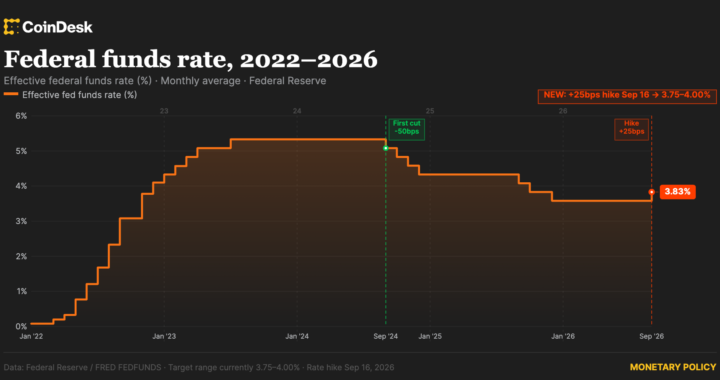
An upcoming Federal Reserve interest rate increase next Wednesday—anticipated to be 25 basis points—is viewed as a virtual certainty at this stage.
Late Friday, Goldman Sachs reversed its earlier prediction that the central bank would maintain steady rates next week, standing as one of the final institutional holdouts on Wall Street.
The bank noted that despite the latest consumer price index release only slightly pushing up their August core PCE prediction to 0.26% without altering their baseline inflation outlook, the FOMC will likely seek to prevent the market backlash that would follow a pause when markets already price in an approximate 90% likelihood of a hike.
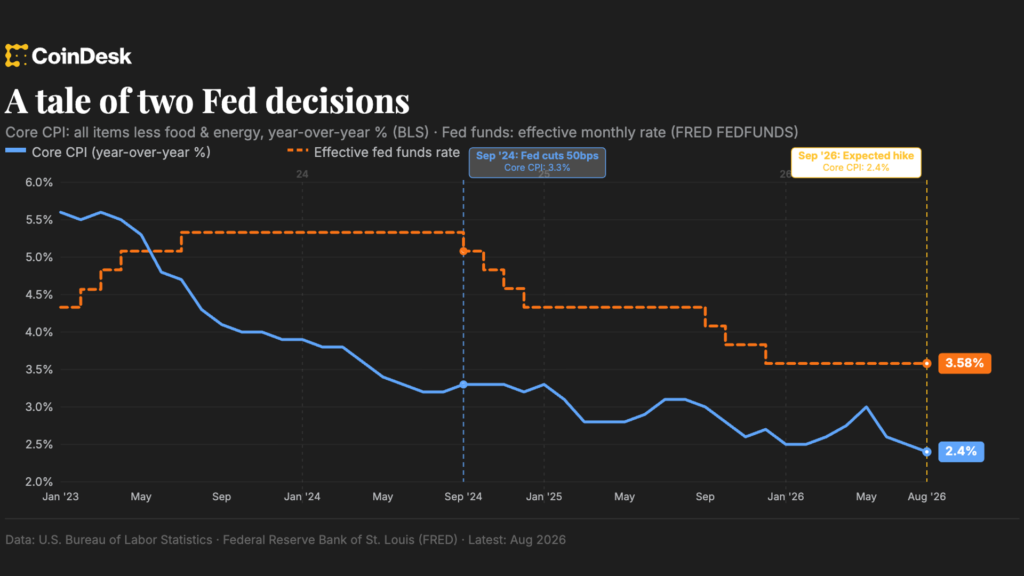
A tale of two Fed decisions
Two years prior, in September 2024, the Federal Reserve initiated an easing cycle while annual core consumer inflation hovered well above 3%. In addition, the central authority opted to reduce its primary federal funds rate by 50 basis points that month instead of the widely anticipated 25.
Presently, two years later, financial markets presume the central bank has no alternative but to launch a tightening cycle next week, even though core consumer inflation has descended to a five-year bottom of 2.4%.
Wall Street, not Main Street
Wellington-Altus chief market strategist James Thorne characterized Goldman’s pivot as “The Wall Street wall of mirrors,” adding that there is no fundamental shift in the inflation outlook, but rather a rate hike designed to appease Wall Street.
He further pointed out that higher interest rates cannot manufacture petroleum, broaden refining output, or fix disrupted supply corridors, noting instead that they suppress demand, capital deployment, labor participation, and consumer buying power.
Thorne highlighted that wage expansion has decelerated to only 3.1% on an annualized basis, emphasizing the absence of a verified wage-price spiral, secondary inflation propagation, or indications that the energy shock is becoming permanent.
He concluded that if the Warsh Fed raises rates merely to validate the futures market narrative of Wall Street, Warsh’s critique of the Wall of Mirrors and pledge to abolish forward guidance will prove entirely hollow.
Inflation may be perkier than core CPI showed
Naturally, not everyone shares Thorne’s perspective.
KPMG chief economist Diane Swonk pointed out that consumer price index increases concentrated heavily in services, noting that super core service costs climbed a sharp 0.5% and advanced 3% year-over-year.
She added that based on the consumer figures, the PCE Index—the Federal Reserve’s preferred metric over the consumer price index—will likely show a 0.4% monthly increase for August, with core components rising 0.3%, driving the annualized core PCE pace to 3.4%, which sits well above the central bank’s 2% objective.
Swonk concluded that they now forecast three rate increases leading into early 2027, noting that the likelihood of a unanimous decision has grown, which would supply a necessary reinforcement to the monetary authority’s inflation-fighting credibility currently desired by the bond market.
Originally published at https://www.coindesk.com/markets/2026/09/13/fed-rate-hike-is-about-wall-street-not-inflation-says-economist.