Bitcoin dropped nearly 3 percent down to $75,800 leading up to the Federal Reserve interest rate verdict, following the Senate rejection of the Clarity Act which removed another potential pillar of support.
Traders have virtually baked in a quarter-point rate increase alongside expectations for more monetary tightening this year, elevating the danger that Fed Chair Kevin Warsh’s commentary will let investors down.
A less aggressive stance could depress the greenback and drive long-term Treasury yields higher over inflation and deficit anxieties, which may ultimately advantage bitcoin and gold following an initial sell-off.
The Senate defeat of the Clarity Act has left supporters of bitcoin at the mercy of Wednesday’s Federal Reserve gathering, an event that select analysts caution could turn out exceptionally demanding for central bank leader Kevin Warsh.
The Federal Reserve is slated to reveal its interest rate determination at 2:00 PM ET, with Warsh hosting a press briefing half an hour later. Prior to the announcement, bitcoin, the premier cryptocurrency by market capitalization, traded at $75,800, marking a drop of almost 3% over the prior 24 hours. The broader cryptocurrency market experienced downward strain as well, with digital tokens such as JUP, XLM, and ICP each slipping around 10%.
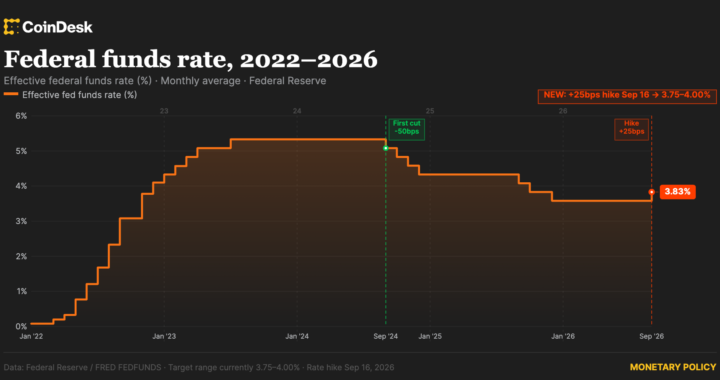
Financial markets have practically fully priced in a 25-basis-point rate lift, which would push the federal funds target band to 3.75%-4%, according to data from CME’s FedWatch tool. Almost every major financial institution additionally anticipates at least one further rate increase before the conclusion of the year, according to metrics presented by Wall Street Journal writer Nick Timiraos.
That combination of hawkish market forecasts complicates the environment for Warsh, noted Robin Brooks, a senior fellow at the Brookings Institution and past chief economist at the Institute of International Finance.
As per Brooks, the central story is not today’s anticipated rate boost, but rather the subsequent policy tightening forecasted later in the year. Warsh might therefore find it difficult to convey a message that matches the aggressive valuations currently present in financial markets.
Tomorrow’s Fed meeting is a nightmare for Warsh. There’s no way he can live up to all the hikes priced, so the press conference will likely disappoint markets. The Dollar is likely to fall and long yields likely to rise, Brooks stated.
A weaker dollar frequently buoys dollar-priced instruments, including bitcoin and gold, mirroring a well-documented inverse relationship between crypto assets and the U.S. Dollar Index (DXY). Furthermore, as Brooks pointed out, longer-term Treasury yields are expected to climb if the press conference falls short of expectations.
The yield catalyst
While rising yields conventionally act as a bearish indicator for non-yielding assets like bitcoin and gold, certain observers emphasize that the underlying catalyst is what counts. In this scenario, yields are projected to ascend due to an inflation warning from the Federal Reserve rather than a positive economic growth outlook, a vital distinction that shifts the standard market playbook.
Based on a JPMorgan scenario analysis highlighted by Barchart, if the Fed elevates rates without offering explicit, hawkish forward guidance, market participants might deduce that present monetary stance remains overly loose, favoring economic expansion over curbing inflation.
Consequently, traders might start pricing in more aggressive tightening over upcoming months, potentially through 50-basis-point increases, pushing yields higher. It is worth noting that Warsh is recognized for his historic opposition toward employing forward guidance.
A comparable threat arises from the perception that a milder tone would erode the Fed’s inflation-battling credibility. Recent inflation metrics have highlighted persistent price pressures, whereas global petroleum benchmarks on both sides of the Atlantic have climbed back past $100 a barrel. Against this background, a less hawkish monetary authority may compel bond buyers to demand a heavier risk premium for holding Treasury obligations, pushing yields upward.
In both frameworks, yields are forecasted to climb for reasons distinct from a favorable economic growth forecast, implying they might not penalize non-yielding holdings like gold and bitcoin.
In reality, both items, widely regarded as sovereign hedges and stores of value, could eventually advance subsequent to an initial risk-off response.
The 10-year Treasury yield is currently sitting near 5%, advancing approximately 80 basis points over the year. Crucially, a large portion of that advance has been fueled by escalating U.S. debt worries.
Originally published at https://www.coindesk.com/markets/2026/09/16/fed-meeting-is-shaping-up-to-be-a-nightmare-for-warsh-bitcoin-might-still-shine.