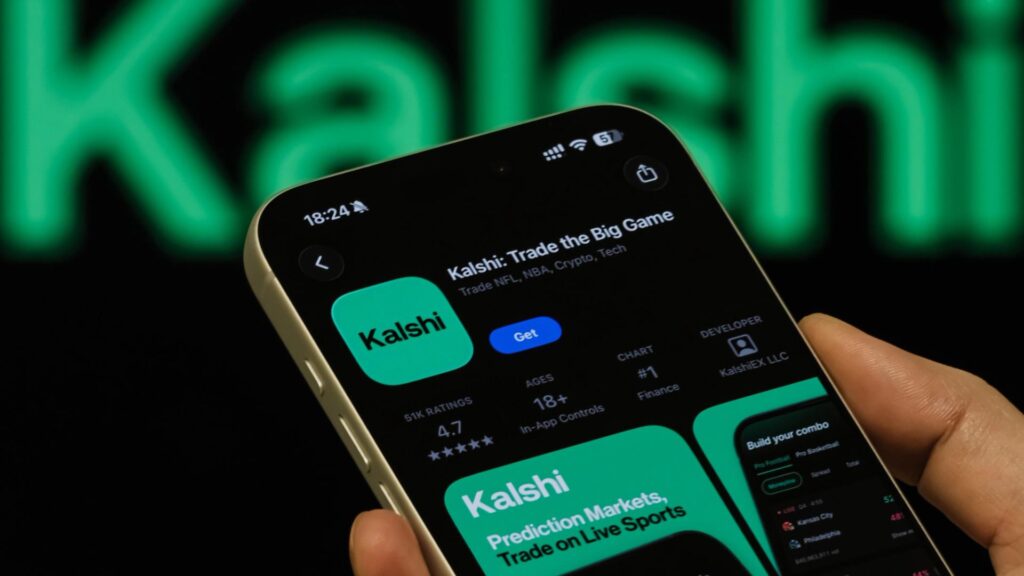
Kalshi intends to pursue regulatory clearance for approximately 60 perpetual futures associated with equities and ETFs, such as Tesla, Apple, and Nvidia, designed for round-the-clock trading.
Should they receive the green light, these agreements would represent the initial regulated single-stock perpetual futures within the United States, permitting leveraged wagers devoid of expiration dates.
Citadel Securities cautioned that shifting equity-centric perpetual futures away from Securities and Exchange Commission supervision might foster an equivalent to a parallel shadow market featuring reduced protections against insider trading and market manipulation.
Prediction platform Kalshi is preparing to introduce one of the cryptocurrency sector’s most favored trading instruments to American equities, featuring perpetual futures linked to corporations like Tesla, Apple, and Nvidia that could operate 24 hours a day.
The exchange operator plans to apply for regulatory permission regarding roughly 60 perpetual contracts tied to individual shares and exchange-traded funds, as detailed by the Wall Street Journal in a report late Thursday.
If sanctioned, these would constitute the inaugural authorized single-stock perps made available in the U.S.
Perpetual futures, frequently termed perps, enable speculators to wager on whether a specific asset will appreciate or depreciate, often utilizing borrowed capital, without the underlying agreement ever terminating.
Instead, participants execute routine periodic transfers amongst themselves that assist in maintaining the contract value close to the spot price of the tracked asset.
Such instruments have evolved into one of the digital asset industry’s massive commercial sectors since the soon-to-be-closed exchange BitMEX debuted these offerings in 2016, with emerging platforms like Hyperliquid enabling users to execute leveraged positions on bitcoin and numerous tokens at any hour.
A Tesla perpetual contract could sustain trading activity throughout nights and weekends while equity shares on the Nasdaq remain shut, establishing a real-time indicator of investor sentiment regarding the corporation’s valuation hours or days prior to the underlying equity reopening.
Nevertheless, this development has sparked anxieties amongst American authorities.
Is a perpetual agreement anchored to a stock classified as a derivative governed by the Commodity Futures Trading Commission, or does jurisdiction lie with the Securities and Exchange Commission, which oversees the underlying equities?
Read More: CFTC asks judge to dismiss CME lawsuit over crypto perpetual futures
Kalshi previously secured CFTC authorization back in May for a bitcoin perpetual contract.
The agency categorized the instrument as a derivative contract, yet cautioned that the framework might prove unsuitable for every asset category while asserting that perps associated with alternate instrument types must undergo individual evaluation.
However, skepticism remains widespread.
Leading trading firm Citadel Securities communicated to both the SEC and the CFTC via a Thursday correspondence that instruments tied to American public corporations ought to stay under SEC supervision.
Relocating them elsewhere risks establishing a parallel shadow market disconnected from the surveillance mechanisms deployed across domestic equities and options, the institution argued.
This apprehension becomes readily apparent when considering enterprises such as Nvidia or Tesla.
An insider possessing non-public financial data could conceivably execute transactions on a perp while the equity exchange is closed.
Similarly, an enterprise might disclose significant announcements during a trading suspension while its perpetual counterpart continues shifting, provided the two venues fail to synchronize.
Citadel noted that SEC oversight already unifies activity across shares, options, and related derivatives, assisting authorities in identifying insider trading or attempts to influence one venue through another.
The organization additionally highlighted mandates concerning trading halts, order execution protocols, and market access that might not automatically transfer if equity-backed perps operate under an alternative regulatory framework.
Digital asset speculators have spent years acquiring leveraged instruments around the clock, leaving the central question of whether an instrument engineered for an uninterrupted marketplace can be successfully integrated into one that halts operations.
Read More: Why a new SEC plan could ease a legal headache for tokenized securities
Originally published at https://www.coindesk.com/markets/2026/09/11/kalshi-wants-24-7-tesla-and-nvidia-perps-as-wall-street-fights-over-who-regulates-them.