Reporting concluded on September 8, 2026, at 9:00 PM.
Copper climbed to an unprecedented peak as supply deficits met expanding demand driven by artificial intelligence.
Oil surges and equities extend losses near the bell following reports of strikes on Iran
As documented in a Wall Street Journal article published just moments ago, Iran initiated strikes directed at American naval vessels on Monday. The Washington military has not yet issued a formal statement regarding these strikes, the article noted.
While no U.S. vessels sustained direct hits, American officials indicated to the Journal that anxiety is mounting over Tehran utilizing more advanced weaponry alongside potential logistical support from Beijing or Moscow.
This bulletin propelled petroleum prices upward, pushing WTI crude up by 2.5% to reach $93.77 for each barrel.
Consequently, equities experienced mild downward pressure as the session concluded, with the S&P 500 dropping 0.55% and the Dow Jones Industrial Average sliding 1.15%. Meanwhile, the Nasdaq composite retreated by a modest 0.35%.
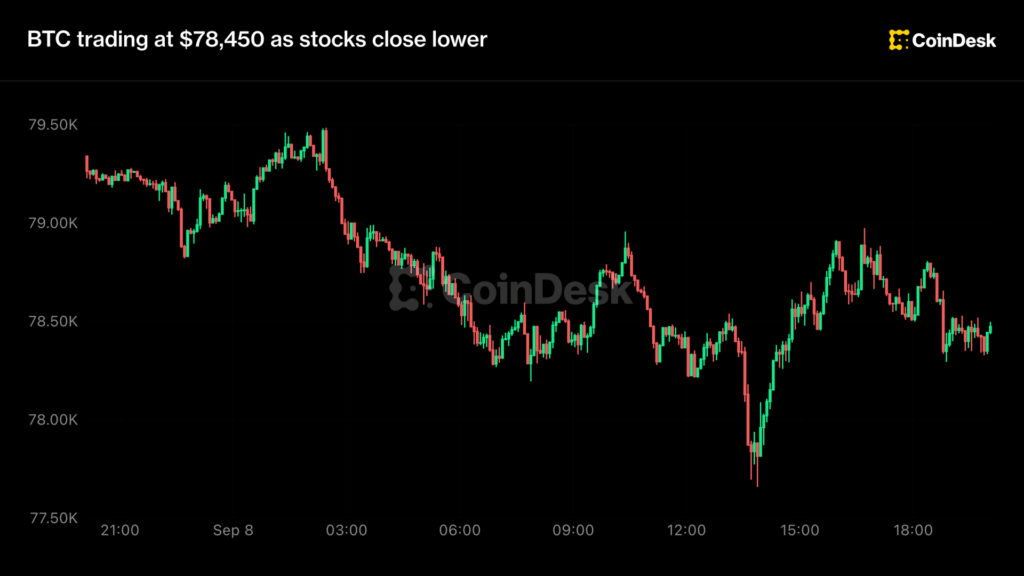
Digital asset bitcoin changed hands at $78,450, marking a 1.15% contraction across the preceding 24 hours.
Bitcoin’s subsequent trajectory could depend on the $80,000 threshold amidst steady ETF accumulation
The premier cryptocurrency’s upcoming direction might rely on exchange-traded fund demand and U.S. borrowing costs after the digital token retreated nearly 3% during the prior five days to settle at $78,600.
Jim Ferraioli, director of digital asset research at Schwab, noted that September has historically proven to be the digital asset sector’s most challenging month, though market positioning appears more resilient following an August short squeeze that eliminated pessimistic bets.
Open interest expanded roughly 16% throughout bitcoin’s latest 26% price surge, indicating that speculators deployed leverage instead of merely closing out short positions. Ferraioli explained that this configuration has historically preceded upward movements, although excessive leverage risks magnifying losses should bitcoin decline.
Wintermute identifies $75,000 and $82,000 as critical thresholds leading up to the Federal Open Market Committee gathering scheduled for September 15 to 16. Spot bitcoin investment vehicles absorbed approximately $1 billion over the prior week, which the market maker noted provided price support despite climbing Treasury yields.
Furthermore, Ferraioli highlighted the $80,000 threshold as an essential cost-basis marker capable of influencing market psychology.
S&P 500 positioned to sustain historical negative streak
The S&P 500 recorded a minor 0.35% loss during the session, with roughly 90 minutes remaining in trading.
Data compiled by Bespoke indicates that if the index finishes the day lower, it would mark the tenth consecutive negative session for this benchmark on a Tuesday immediately following Labor Day.
Over the past decade, the typical post-Labor Day weekly decline averaged 0.8%, while the remainder of September historically yields a negative 1.17% return. Conversely, the balance of the calendar year has tended to be constructive, delivering an average gain of 3.57%.
Political pressure compelled Silvergate shutdown, asserts former chief executive Alan Lane
In an extensive Substack publication released on Tuesday, former bank head Alan Lane stated that Silvergate did not collapse and, supported by its exceptional staff, remained fully capable of continuing client operations. Lane asserted that faced with regulatory pressure originating from the Biden administration, Silvergate elected to execute an orderly, voluntary wind-down of its business activities.
Lane maintained that his financial institution successfully weathered a severe 70% deposit withdrawal wave during the fourth quarter of 2022.
Lane contended that under an alternative political climate, banking authorities would likely have commended the successful implementation of Silvergate’s liquidity preservation framework. Instead, over the subsequent months, the institution transformed into a primary target of the administration’s regulatory hostility toward the cryptocurrency sector.
Digital asset valuations recover, erasing earlier session declines
After registering minor losses during early Tuesday trading, several prominent cryptocurrencies exhibited positive momentum during U.S. midday activity.
XRP led the advance, appreciating 3.6% over the trailing 24-hour window to trade at $1.43. Ether and solana posted more modest increases, rising 1.2% and 1%, respectively.
Following an intraday dip below the $78,000 mark earlier in the morning, bitcoin recovered to $78,850, bringing its 24-hour performance to flat.
American equities traded well above their session lows, with the Nasdaq index showing a minimal contraction of just 0.1%.
This recovery may have received assistance from stabilizing petroleum valuations; after threatening to breach the $100 per barrel mark earlier, Brent crude retreated to $97.50, representing a daily gain of only 0.6%.
Implement swift monetary tightening: Bond market veteran advocates for 50-basis-point Federal Reserve reduction
Writing in a commentary published Tuesday morning, Harley Bassman suggested that government bond yields are testing twenty-year highs primarily because market participants lack confidence in the U.S. administration’s stewardship of fiscal policy.
Bassman continued that characterized by what can only be described as severe fiscal mismanagement since 2001, administrations spanning both political parties transformed a federal budget surplus into an enduring 6% deficit while total national debt expanded from $5.8 trillion to exceed $40 trillion.
Bassman argued that Federal Reserve Chairman Kevin Warsh must execute a decisive policy shock to convince observers of his absolute commitment to defending the U.S. dollar. Although potentially unnecessary from a pure economic standpoint, a 50-basis-point adjustment would signal the arrival of leadership independent of executive branch influence.
With financial markets having already incorporated a total of 50 basis points of monetary tightening before year-end, Bassman concluded that monetary authorities should simply execute the adjustment immediately and move forward.
Qualcomm advances following artificial intelligence server chip partnership with Amazon
Qualcomm disclosed a multi-generational partnership agreement with Amazon focused on delivering customized silicon infrastructure for Amazon Web Services artificial intelligence operations.
The arrangement entails potential financial outlays reaching up to $60 billion, alongside Qualcomm issuing Amazon warrants for up to 25 million shares of company stock at an exercise price of $161.26.
Shares of Qualcomm, which recently experienced downward volatility, climbed 7% to reach $180.40 following the announcement.
The Wall Street Journal reported that Robinhood integrated Crypto.com binary prediction contracts into its application while simultaneously acquiring minority equity positions in both Crypto.com and prediction marketplace platform OG.
Robinhood equity shares increased approximately 2% during pre-market trading activity.
The brokerage firm initially introduced prediction market contracts via Kalshi earlier in the year as market interest expanded. Crypto.com has facilitated similar contracts through its derivatives division since late 2024 and established OG in February. Chief Executive Kris Marszalek reported to the Journal that OG experienced an approximate twentyfold expansion over the course of the year.
Financial terms of the investments were withheld, though Crypto.com and OG commanded valuations of $15 billion and $5 billion, respectively, following equity acquisitions executed by Citadel Securities in July.
Bitmine Immersion accumulated roughly 30,000 ether throughout the preceding week
Bitmine Immersion expanded its digital asset treasury, reaching 5.93 million ether tokens—representing approximately 4.9% of the circulating supply—following the acquisition of roughly 30,000 ether during the previous week.
Chairman Tom Lee remarked that multiple favorable catalysts are emerging as the market approaches the conclusion of 2026. These developments include the anticipated legislative vote on the CLARITY Act scheduled for mid-September. Furthermore, South Korean capital has begun reallocating back into cryptocurrencies away from artificial intelligence equities. In their assessment, the traditional four-year market cycle is establishing a definitive bottom within the coming weeks, laying the groundwork for substantial institutional capital deployment into digital assets toward the end of 2026, supported by structural tailwinds including asset tokenization and autonomous agent artificial intelligence.
Copper prices escalate to unprecedented all-time highs
Commentators at Market Ear by ZeroHedge noted that import tariffs initiated the supply squeeze, while expanding electricity requirements for artificial intelligence applications threaten to prolong it, as copper climbed an additional 2% on Monday to establish a fresh record peak surpassing $6.80 per pound.
Former Goldman Sachs commodities chief Jeff Currie remarked that this dynamic represents the latest indication that physical commodity markets are repricing terrestrial resource scarcity.
Currie emphasized that constructing data centers, expanding electrical grids, industrial electrification, and duplicating supply chains remain impossible without adequate copper supplies.
He added that adverse weather patterns, geopolitical conflicts, and regulatory frameworks constitute the three primary factors compounding historical underinvestment—marking the resurgence of the physical economy—to generate a structural deficit showing no immediate path toward resolution. Skeptics may argue that the metal physically exists, but if locked away within warehouse facilities, it functions merely as stored material.
Capitalizing on strong valuations for both common and preferred equities, Matt Cole’s firm Strive acquired 1,375 bitcoin over the past week, expanding total treasury holdings to 24,531 coins.
The organization divested upward of 2 million shares of common stock alongside over 900,000 shares of its high-yielding preferred equity instrument, designated as SATA, which traded near its par value of $100 throughout the week.
Strive equity shares declined 2.7% during pre-market transactions alongside a concurrent retreat in bitcoin toward the $78,000 threshold.
Strategy repurchased $176 million of its high-yielding STRC preferred stock during the previous week, according to regulatory filings submitted Monday morning.
Additionally, the corporate treasury expanded its authorized share repurchase allocation from $1 billion to $2 billion.
These capital outlays utilized existing corporate cash reserves, leaving the organization’s bitcoin reserves unchanged at 845,050 coins.
Strategy equity shares retreated 3% during pre-market operations as bitcoin revisited the $78,000 level.
According to Bloomberg coverage, the People’s Bank of China acquired 650,000 ounces of bullion for its official reserves, representing its largest monthly precious metals purchase since 2023. This acquisition extended the central bank’s continuous gold purchasing campaign to 22 consecutive months.
Precious metals previously surged to an all-time high of $5,600 per ounce in January 2026 before experiencing an approximate 20% correction, currently consolidating near $4,400 per ounce.
Stablecoin transaction activity across Visa infrastructure is accelerating rapidly. Powered by an extensive expansion of crypto-enabled payment card solutions, Visa’s annualized stablecoin settlement throughput increased fifteenfold year-over-year to surpass the $20 billion milestone.
Visa disclosed in a Tuesday publication that its ecosystem currently encompasses more than 160 operational stablecoin card initiatives worldwide, with transaction volumes surging nearly 200% over the trailing twelve months.
This rapid expansion requires participating card issuers to provision their own capital upfront to fund daily settlement obligations before end users settle their respective balances. For smaller emerging enterprises, managing this daily liquidity requirement amounts to several million dollars, rendering traditional commercial banking credit facilities excessively costly and impractical.
The most consequential macroeconomic release of the week arrives Friday with the publication of U.S. inflation metrics. Current financial market pricing reflects roughly a 60% probability assigned to a 25-basis-point borrowing cost adjustment, according to data from the CME FedWatch utility.
General consumer price inflation is projected to advance 2.4% on an annualized basis and 0.4% monthly. Core inflation, which excludes volatile food and energy components, is anticipated to register a 2.4% annual increase alongside a 0.2% monthly rise.
The market share of bitcoin capitalization relative to the broader digital asset economy registered a decline for the fifth consecutive trading session.
This multi-day downward movement reduced the metric from 60.41% down to 59.35%, based on statistics provided by TradingView.
This trend highlights capital rotation into alternative digital assets following the August market expansion that propelled bitcoin valuations rapidly upward from approximately $63,000 to $80,000.
Several alternative digital assets, including ARB, DASH, and ZEC, recorded price appreciations ranging between 30% and 50% over a single week.
Futures contracts tied to West Texas Intermediate crude oil traded at $94.44 at the time of publication, marking the highest valuation recorded since June 8, according to TradingView records.
Commodity valuations have advanced 9.5% throughout the current month, reigniting concerns regarding persistent inflation. Combined with Friday’s robust domestic employment report, these dynamics led traders to price in a 60% probability of Federal Reserve interest rate adjustments during the upcoming September 16 meeting, as indicated by CME FedWatch data.
Consequently, bitcoin traded under sustained downward pressure, changing hands at $78,400, reflecting a 0.9% contraction since midnight Coordinated Universal Time.
Risk-averse sentiment reemerged on Tuesday following the U.S. Labor Day holiday closure. The Japanese yen extended its appreciation against the American dollar, strengthening past the 154 threshold to touch 152.99, marking its strongest valuation since February. This monetary movement reignited apprehensions regarding the potential unwinding of speculative yen carry trade positions, which could impose additional headwinds on worldwide risk assets.
Digital asset bitcoin retreated in excess of 1% across the trailing 24-hour window, consolidating immediately above $78,000, while gold depreciated 1% to reach $4,390 per ounce. Technology equities likewise drifted lower during pre-market activity, with the Invesco QQQ exchange-traded fund sliding 0.16%.
Petroleum valuations maintained their upward trajectory, with Brent crude moving toward $100 per barrel, representing a 24-hour gain of 2% and touching its highest level since June. WTI crude approached $95 per barrel following a 3.5% advance.
Concurrently, international sovereign borrowing costs climbed higher, with the U.S. 10-year Treasury yield firmly exceeding 4.8%, while equivalent government bond yields in the United Kingdom, France, and Germany likewise registered upward movement.
Originally published at https://www.coindesk.com/tech/2026/09/08/live-updates.